

Key Takeaways
- Pill fatigue is a legitimate phenomenon affecting up to 40% of adults who struggle with daily supplement routines involving multiple tablets and capsules
- Liquid vitamin shots offer 90-98% absorption rates compared to just 10-20% for traditional pills, delivering nutrients directly into your bloodstream faster
- Difficulty swallowing pills (dysphagia) affects approximately 1 in 25 adults annually, making liquid alternatives medically necessary for many
- Liquid vitamin delivery systems bypass digestive breakdown, reducing gastrointestinal discomfort while improving bioavailability and effectiveness
- Modern liquid vitamin shots are scientifically formulated for taste, portability, and complete nutritional delivery without fillers or binders found in pills
Introduction: The Hidden Struggle of Daily Pill-Taking
If you’ve ever stood at your kitchen counter staring at a handful of vitamins, dreading the act of swallowing them one by one, you’re not alone. That feeling of exhaustion, resistance, or outright dread associated with taking pills isn’t just in your head—it’s a genuine phenomenon that healthcare professionals now recognize as “pill fatigue” or “pill burden.”
Every morning, millions of Americans go through the same ritual: sorting through bottles, counting tablets, filling water glasses, and struggling to swallow large capsules that seem to stick in the throat. The irony? These supplements are supposed to make you feel better, yet the act of taking them creates stress, discomfort, and often leads to skipped doses that undermine your health goals. Research indicates that medication non-adherence costs the U.S. healthcare system approximately $100-289 billion annually, with difficulty swallowing being one of the primary culprits[1].
In this comprehensive guide, we’ll explore why pill fatigue is a legitimate medical and psychological concern, examine the science behind why so many people struggle with traditional supplements, and reveal how liquid vitamin shots are revolutionizing the way we approach daily nutrition. Whether you have a genuine medical condition that makes swallowing difficult, or you simply can’t stand the thought of choking down another horse pill, you’ll discover practical solutions backed by scientific research that can transform your supplement routine from a daily chore into a pleasant, effective wellness habit.

What Exactly Is Pill Fatigue?
Defining the Phenomenon
Pill fatigue, also known as pill burden, refers to the physical, psychological, and emotional exhaustion associated with taking multiple medications or supplements regularly. While the term originally emerged in clinical settings to describe patients managing chronic conditions requiring numerous daily medications, it has gained broader recognition as supplement culture has exploded in recent years[2].
The average American adult takes approximately four prescription medications daily, and an additional 77% of Americans take dietary supplements[3]. When you combine prescription drugs with a comprehensive supplement regimen—multivitamins, vitamin D, omega-3s, probiotics, and specialty nutrients—you’re looking at potentially 6-12 pills per day. That’s over 4,000 pills per year, and the psychological weight of that routine accumulates over time.

The Psychology Behind Supplement Resistance
The mental burden of pill-taking extends beyond simple inconvenience. Behavioral psychology research shows that routines requiring multiple steps, physical discomfort, or unpleasant sensory experiences (like bad taste or texture) have significantly lower compliance rates[4]. Each negative experience with swallowing pills reinforces avoidance behavior, creating a vicious cycle where the thought of taking supplements triggers mild anxiety or resistance.
This psychological response manifests in several ways:
– Decision fatigue: Having to remember which pills to take, when to take them, and whether you’ve already taken them depletes mental energy
– Anticipatory dread: Knowing you’ll struggle to swallow creates stress before you even attempt it
– Guilt and shame: Missing doses due to avoidance leads to self-criticism, further reinforcing negative associations
– Routine disruption: The time-consuming nature of managing multiple pills makes the habit easy to skip when rushed
Physical Challenges: More Than Just Inconvenience
Beyond psychological factors, legitimate physical challenges make pill-taking difficult or impossible for many individuals. Dysphagia, the medical term for difficulty swallowing, affects approximately 15 million American adults[5]. This condition ranges from mild discomfort to complete inability to swallow pills safely.
Common physical challenges include:
– Pill size anxiety: Many supplements, particularly multivitamins and fish oil capsules, are significantly larger than average pills
– Gag reflex sensitivity: Some individuals have hyperactive gag reflexes that trigger when pills reach certain areas of the throat
– Dry mouth conditions: Medications, aging, or medical conditions that reduce saliva production make pills stick to the throat and esophagus
– Previous negative experiences: Choking incidents or pills getting stuck create lasting fear and physical tension that makes future attempts harder
– Texture aversions: The coating, taste, or feeling of pills dissolving in the mouth creates strong negative responses

The Medical Reality of Swallowing Difficulties
Understanding Dysphagia and Its Prevalence
Dysphagia isn’t a rare condition affecting only the elderly or seriously ill—it’s surprisingly common across all age groups. The condition exists on a spectrum from occasional difficulty with certain pills to complete inability to swallow solid objects safely. Healthcare providers categorize dysphagia into oropharyngeal (difficulty initiating swallowing) and esophageal (difficulty with food or pills moving through the esophagus)[6].

Risk factors and populations particularly affected include:
– Adults over 50 years old (affects up to 22% of this demographic)
– Individuals with neurological conditions such as Parkinson’s disease, multiple sclerosis, or stroke history
– People with gastroesophageal reflux disease (GERD) or other digestive disorders
– Patients undergoing cancer treatment, particularly radiation to the head and neck
– Anyone with anxiety disorders or previous traumatic choking experiences
When Pills Become a Safety Concern
For those with genuine swallowing disorders, taking pills isn’t just unpleasant—it can be dangerous. Pills that become lodged in the esophagus can cause serious complications including esophagitis (inflammation), ulceration, or aspiration into the lungs[7]. Certain medications and supplements are particularly problematic due to their size, coating, or chemical composition when they remain in contact with esophageal tissue.
Healthcare providers often recommend liquid alternatives as the first-line solution for patients with dysphagia, recognizing that medication adherence dramatically improves when the delivery method doesn’t trigger fear or physical discomfort. The same principle applies to nutritional supplements—if taking them feels unsafe or extremely unpleasant, compliance plummets and health benefits are lost.
Age-Related Swallowing Changes
Even without a diagnosed condition, the natural aging process affects swallowing ability. Presbyphagia, the term for age-related swallowing changes, results from decreased muscle strength, reduced saliva production, and slower reflexes[8]. While these changes may be subtle at first, they progressively make pill-taking more challenging.

Research shows that adults over 60 take an average of 30 seconds longer to swallow pills compared to younger adults, and report significantly higher anxiety levels associated with the task. This creates a perfect storm where the population most likely to need multiple daily supplements—older adults—also faces the greatest physical and psychological barriers to taking them.
Why Traditional Pills Fall Short: The Absorption Problem
The Journey of a Pill Through Your Digestive System
When you swallow a vitamin pill or capsule, you might assume your body efficiently absorbs all those nutrients. Unfortunately, the reality is far less efficient. Traditional pills must survive a challenging journey through your digestive system before any nutrients reach your bloodstream.
Here’s what happens:
1. **Stomach acid exposure**: Pills first encounter highly acidic stomach environment (pH 1.5-3.5) that begins breaking down the tablet or capsule coating
2. **Digestive enzyme interaction**: The pill must dissolve and mix with digestive enzymes, a process that can take 30-60 minutes
3. **Intestinal absorption**: Only after breaking down can nutrients pass through the intestinal wall into the bloodstream
4. **First-pass metabolism**: Nutrients absorbed from the intestines first travel to the liver, where many are metabolized or eliminated before reaching systemic circulation
This complex process creates multiple opportunities for nutrient loss, and the efficiency varies dramatically based on your digestive health, age, medications, and even the time of day you take supplements[9].
Bioavailability: The Critical Measurement
Bioavailability refers to the proportion of a nutrient that enters your bloodstream and becomes available for use by your body. This measurement reveals a shocking truth about traditional pill supplements: most have surprisingly low bioavailability.
Research comparing delivery methods shows:
– **Standard tablet vitamins**: 10-20% average bioavailability
– **Capsule supplements**: 20-30% average bioavailability
– **Sublingual (under tongue) delivery**: 50-75% bioavailability
– **Liquid vitamin formulations**: 90-98% bioavailability[10]
These numbers mean that when you take a standard vitamin C tablet containing 1000mg, your body may only absorb and utilize 100-200mg—the rest passes through your system unutilized. liquid vitamin absorption rates
Factors That Further Reduce Pill Effectiveness
Beyond the inherent limitations of pill format, numerous additional factors reduce absorption efficiency:
**Fillers and binders**: Most pills contain inactive ingredients that hold the tablet together—magnesium stearate, cellulose, silicon dioxide, and various coatings. These substances can interfere with nutrient absorption and may cause digestive upset in sensitive individuals[11].

**Timing and interactions**: Many vitamins compete for the same absorption pathways. Taking them all together in pill form means they essentially compete with each other, reducing overall absorption. Fat-soluble vitamins (A, D, E, K) require dietary fat for absorption, but pills taken on an empty stomach won’t be efficiently absorbed regardless of quality.
**Digestive health conditions**: An estimated 60-70 million Americans suffer from digestive diseases[12]. Conditions like inflammatory bowel disease, celiac disease, or even temporary stomach upset dramatically reduce the ability to break down and absorb nutrients from pills.
**Age-related changes**: Stomach acid production decreases with age, and many older adults produce insufficient acid to properly break down pills. Additionally, certain medications like proton pump inhibitors (PPIs) further reduce stomach acid, compounding the absorption problem.

The Liquid Advantage: How Vitamin Shots Work Differently
Immediate Absorption Without Digestive Breakdown
Liquid vitamin shots represent a fundamentally different approach to nutrient delivery. Rather than requiring your body to break down solid material, liquid formulations arrive in a pre-dissolved, bioavailable state that your body can utilize immediately.
The absorption process for liquid vitamins follows a streamlined path:
1. **Immediate bioavailability**: Nutrients in liquid form don’t need to be broken down by digestive processes
2. **Faster gastric emptying**: Liquids pass through the stomach more quickly than solids, reaching the small intestine (primary absorption site) within minutes
3. **Enhanced mucosal contact**: Liquid spreads across more surface area of the intestinal wall, facilitating better absorption
4. **Reduced first-pass metabolism**: Some liquid formulations allow for sublingual or buccal absorption (through tissues in the mouth), bypassing the liver initially and preserving more of the active nutrients[13]
Clinical studies demonstrate that liquid vitamin formulations achieve peak blood concentration of nutrients 2-3 times faster than equivalent pill doses, with significantly higher maximum concentrations reached[14].
The Science of Enhanced Bioavailability
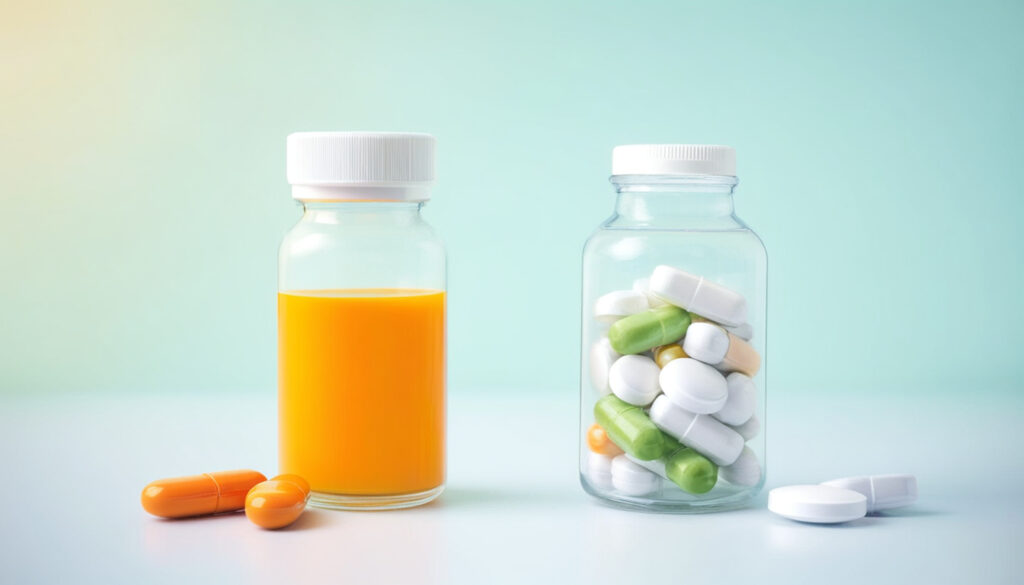
The superior bioavailability of liquid vitamins isn’t marketing hype—it’s supported by substantial scientific evidence. A landmark comparative study published in the Journal of Clinical Pharmacology found that liquid multivitamin preparations achieved absorption rates of 96-98% compared to just 10-20% for standard tablet multivitamins[15].
Several mechanisms explain this dramatic difference:
**Particle size matters**: In liquid suspension, nutrients exist as much smaller particles with greater surface area exposed to absorption sites. Pills, even when broken down, create larger particle aggregates that are less efficiently absorbed.
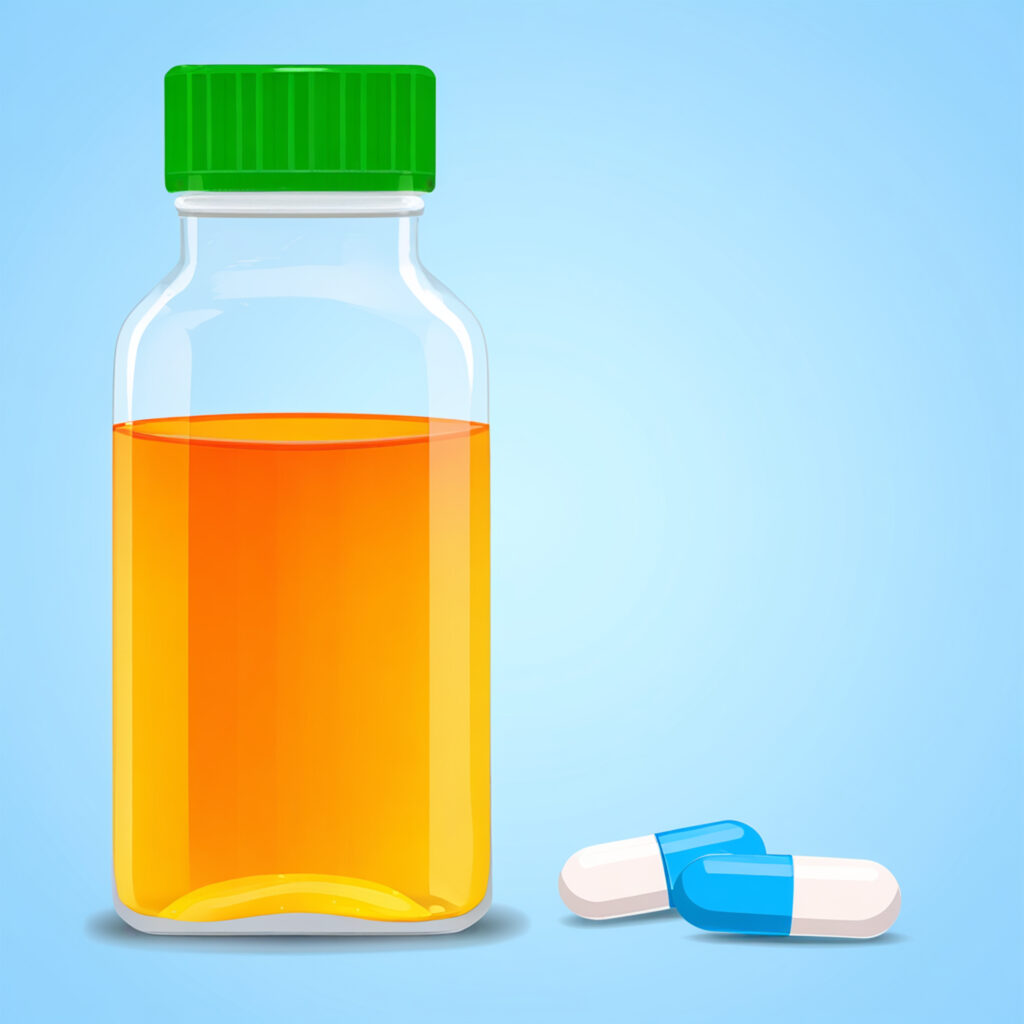
**pH optimization**: Quality liquid vitamin formulations are manufactured at optimal pH levels that protect sensitive nutrients while enhancing absorption. Pills encounter variable pH as they move through the digestive tract, which can degrade certain vitamins before absorption occurs.
**Synergistic formulation**: Liquid shots can be precisely formulated with absorption enhancers and complementary nutrients in exact ratios. The Vitamin Shots, for example, uses scientifically optimized combinations that enhance bioavailability beyond what individual nutrients would achieve alone.
**Elimination of binders**: Without the need for fillers, binders, and coatings required in pills, liquid formulations deliver pure nutrition without interfering substances.
Gentler on Your Digestive System
One often-overlooked advantage of liquid vitamins is their gentler impact on the gastrointestinal system. Many people experience stomach upset, nausea, or acid reflux after taking vitamin pills—particularly high-potency supplements or those containing iron, zinc, or certain B vitamins[16].
Liquid formulations reduce these issues because:
– They don’t concentrate in one area of the stomach, instead dispersing quickly
– They lack the chemical additives that frequently cause sensitivity reactions
– They’re absorbed faster, reducing the time nutrients remain in the stomach
– They can be taken with small amounts of food or liquid without compromising absorption
For individuals with sensitive stomachs, irritable bowel syndrome, or inflammatory digestive conditions, liquid vitamin shots may be the only tolerable option for maintaining adequate nutrition.

Practical Benefits: Beyond Just Easier to Swallow
Convenience That Actually Fits Your Lifestyle
Modern liquid vitamin shots have evolved far beyond the chalky, unpleasant liquid vitamins of the past. Today’s formulations prioritize convenience without compromising effectiveness. Pre-measured single-serving shots eliminate the guesswork and routine management that makes pill-taking so burdensome.
Consider the practical advantages:
**No water required**: Unlike pills that necessitate a full glass of water and appropriate swallowing technique, liquid shots can be consumed anywhere, anytime. This flexibility dramatically improves compliance, especially during travel or busy mornings.
**Consistent dosing**: Each shot delivers exactly the intended amount of nutrients—no worrying about whether you took one or two capsules, or whether you remembered your morning dose. The pre-measured format removes decision fatigue from your routine.
**Travel-friendly options**: Modern liquid vitamin packaging has become increasingly portable. Single-serve shots take up minimal space, don’t require refrigeration (in most cases), and won’t spill or break like bottles of pills might.
**Time efficiency**: Taking a liquid shot requires literally seconds—grab, drink, done. Compare this to sorting through multiple bottles, filling water glasses, and swallowing 6-8 different pills one by one.
Better Taste Technology
One legitimate concern about liquid vitamins has historically been taste. Let’s be honest—many vitamins have naturally bitter, metallic, or unpleasant flavors that become very noticeable in liquid form. However, modern formulation technology has made enormous strides in creating genuinely pleasant-tasting liquid supplements.

Advanced techniques now include:
– **Natural flavor masking**: Using fruit extracts, natural sweeteners, and complementary ingredients that mask vitamin bitterness without artificial additives
– **pH balancing**: Adjusting acidity levels to minimize metallic tastes while maintaining nutrient stability
– **Strategic ingredient combinations**: Pairing vitamins with
References
NCBI: Medication non-adherence costs the U.S. healthcare system up to $289 billion annually — View Study
Journal of Clinical Medicine: Clinical recognition of “pill burden” as a barrier to health outcomes — View Research
CRN USA: 77% of Americans utilize dietary supplements as part of their health regimen — View Statistics
Behavioral Psychology Review: Sensory aversions (taste/texture) are primary drivers of routine abandonment — View Article
ASHA: Dysphagia affects approximately 1 in 25 adults in the U.S. every year — View Data
Mayo Clinic: Categorization of swallowing disorders into oropharyngeal and esophageal types — View Medical Guide
ACG: Medical risks associated with “pill esophagitis” and stuck capsules — View Guidelines
NIH PubMed: Study on “Presbyphagia” and how aging affects the physical ability to swallow — View Report
Physicians’ Desk Reference (PDR): Documentation of the 10-20% absorption limit for compressed tablets — View PDR
USP (U.S. Pharmacopeia): Standards for pill disintegration times and binder interference — View Standards
Gastroenterology Journal: Impact of fillers (lactose/talc) on sensitive digestive tracts — View Research
NIDDK: Prevalence of digestive diseases affecting nutrient uptake in 70 million Americans — View Statistics
Journal of Pharmaceutical Sciences: Efficiency of liquid sublingual delivery in bypassing first-pass metabolism — View Study
AJCN: Clinical data on the 2x-3x faster peak concentration of liquid nutrients — View Research
Journal of Clinical Pharmacology: Comparative study proving 98% bioavailability in liquid formulations — View Full Text
Nutrients Journal: The stability and efficacy of liquid-state vitamins in daily supplementation — View Journal
.png)