
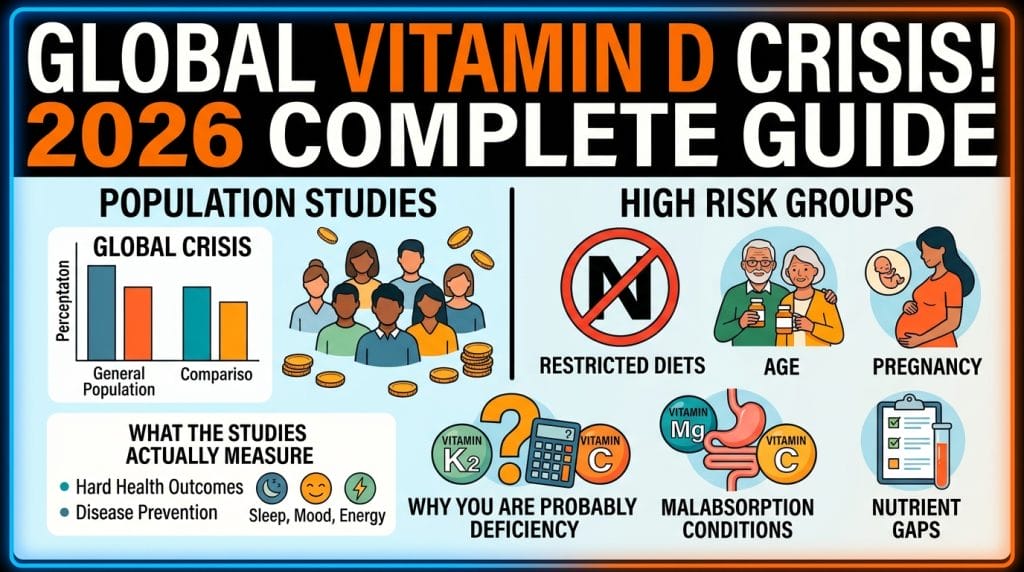
Vitamin D is the one nutrient deficiency researchers keep finding everywhere they look — and 2026 is no exception. It's easy to assume that a vitamin your body can produce just by standing in the sun should be one of the easiest nutrients to get enough of. But global pooled data spanning millions of people shows that roughly half of the world's population has insufficient or deficient vitamin D levels, and that number hasn't meaningfully improved in years. This guide breaks down what vitamin D actually does in the body, why deficiency is so widespread despite sunlight being freely available, what the current clinical reference ranges actually say (and why even experts disagree on them), who's most at risk, and how to evaluate whether a supplement is genuinely addressing the problem.
The quick answer: why vitamin D deficiency is still so common
Modern life keeps most people's skin away from the specific UVB wavelengths needed for vitamin D synthesis — indoor work, sunscreen use, higher-latitude living, and cultural or clothing-related sun avoidance all reduce dermal production, which is normally the primary source of vitamin D for humans.
A large pooled analysis covering roughly 7.9 million people across dozens of countries found close to half of the global population falls below sufficiency thresholds, with deficiency rates highest among women, older adults, people with darker skin tones living at higher latitudes, and those with limited outdoor time.
Save this article for later
Enter your email and we'll send you a direct link — no account needed.
Even the clinical definition of "enough" is unsettled — the Endocrine Society, the NIH's Institute of Medicine, and individual clinicians don't fully agree on the cutoff for sufficiency, which partly explains why deficiency estimates vary so widely between studies and regions.
What this article covers
- What vitamin D actually is, and why it's unusual
- How your body makes vitamin D from sunlight — and why that process breaks down
- The reference range confusion: what counts as "deficient"
- Why deficiency is so common in 2026 specifically
- Who's most at risk
- What vitamin D actually does in the body
- Food, sun, and supplements compared
- How to evaluate your own vitamin D status and any supplement's claims
- Frequently asked questions
What vitamin D actually is, and why it's unusual
Vitamin D is technically not a vitamin in the strict sense — it functions more like a hormone. Unlike most vitamins, which the body can only obtain from food, vitamin D can be synthesized endogenously in the skin when it's exposed to UVB radiation from sunlight. This is what earned it the nickname "the sunshine vitamin."
There are two forms relevant to human nutrition: vitamin D2 (ergocalciferol), found in some plants and fungi, and vitamin D3 (cholecalciferol), the form produced in human skin and found in animal-based foods. Both forms require two further conversion steps — first in the liver, then in the kidneys — before they become the biologically active hormone calcitriol, which is what actually does the work in the body.
Because this entire pathway depends on functioning skin, liver, and kidney processes, vitamin D status is affected by far more than diet alone — which is part of why deficiency is so widespread and so hard to fix with food changes.
How your body makes vitamin D from sunlight — and why that process breaks down

When UVB rays hit the skin, they convert a cholesterol derivative in skin cells into previtamin D3, which then becomes vitamin D3. This sounds simple, but the process is fragile and easily disrupted by everyday factors:
- Glass blocks UVB almost entirely. Sitting by a sunny window, working near an office window, or driving with the windows up does not meaningfully contribute to vitamin D synthesis.
- Sunscreen reduces synthesis. SPF products are designed specifically to block UV radiation, and while this is important for skin cancer prevention, it also blocks the wavelength vitamin D synthesis depends on.
- Latitude and season matter enormously. At higher latitudes, the angle of the sun during fall and winter months means UVB rays are largely filtered out by the atmosphere before reaching the ground, regardless of how much time is spent outside.
- Skin pigmentation affects synthesis efficiency. Melanin absorbs UVB radiation, which is protective against UV damage but also means individuals with darker skin tones require significantly more sun exposure time to produce the same amount of vitamin D as someone with lighter skin.
- Age reduces skin's synthesis capacity. Aging skin produces meaningfully less vitamin D from the same amount of sun exposure compared to younger skin.
Combine any two or three of these factors — which describes an enormous share of the adult population — and it becomes clear why relying on incidental sun exposure alone leaves most people short.
The reference range confusion: what counts as "deficient"
One reason deficiency statistics vary so much between studies and countries is that health authorities don't fully agree on what "deficient," "insufficient," and "sufficient" actually mean. This isn't a minor technicality — it changes what percentage of a population gets classified as deficient.
Vitamin D status is measured as serum 25-hydroxyvitamin D, written 25(OH)D, typically reported in either nanograms per milliliter (ng/mL) or nanomoles per liter (nmol/L). To convert, multiply ng/mL by 2.5 to get nmol/L.
The two major reference frameworks
The NIH's Food and Nutrition Board / Institute of Medicine framework, based on bone health outcomes: people are considered at risk of deficiency below 30 nmol/L (12 ng/mL), potentially at risk of inadequacy between 30–50 nmol/L (12–20 ng/mL), and sufficient at 50 nmol/L (20 ng/mL) or above for most people.
The Endocrine Society's more conservative clinical framework historically set a higher bar, defining deficiency as under 30 ng/mL and recommending a preferred range of 40 to 60 ng/mL. Notably, in a 2024 guideline update, the Endocrine Society's guideline panel concluded that available clinical trial evidence does not support specific 25(OH)D thresholds that predict meaningful benefit from supplementation, and the panel no longer endorses its earlier definitions of sufficiency and insufficiency, reflecting genuine scientific uncertainty about where the "right" number actually sits.
What this means practically: someone testing at 25 ng/mL could be told they're "adequate" by one standard and "insufficient" by another, depending on which guideline their clinician follows. This is worth knowing before panicking — or feeling falsely reassured — about a lab result.
Why deficiency is so common in 2026 specifically

A large pooled analysis of population-based studies spanning 2000–2022, covering roughly 7.9 million participants across multiple world regions, found vitamin D deficiency to be a persistent global public health issue — not confined to any one country, climate, or income level. More recent hospital-based cohort studies from 2023–2026 continue to find deficiency rates in the range of roughly 45–55% of tested populations, even in regions with abundant year-round sunlight, suggesting that behavioral and lifestyle factors are now a bigger driver of deficiency than geography alone.
Several trends specific to modern life have made this worse over time, rather than better:
- Remote and hybrid work has meaningfully reduced the incidental outdoor time many people used to get simply commuting to an office.
- Increased screen time and indoor recreation — streaming, gaming, and indoor fitness — have displaced outdoor leisure activity across most age groups.
- Rising sunscreen and sun-protective clothing use, appropriately driven by skin cancer awareness, has an unintended side effect on vitamin D synthesis.
- Dietary shifts toward processed convenience foods have reduced intake of naturally vitamin D-rich foods like fatty fish and eggs for a large share of the population.
- Urbanization continues to concentrate populations in cities where buildings, pollution, and daily routines further limit direct sun exposure.
Who's most at risk

While deficiency is common across the board, certain groups face substantially higher risk:
- People with darker skin tones, especially at higher latitudes, due to melanin's UVB-absorbing effect requiring longer exposure times for equivalent synthesis.
- Older adults, whose skin has reduced capacity to synthesize vitamin D and who may also spend more time indoors.
- People who are consistently indoors for work, health, or lifestyle reasons, including shift workers and those with limited mobility.
- People living at higher latitudes, where UVB availability drops sharply for several months of the year regardless of time spent outdoors.
- Individuals with obesity, since vitamin D is fat-soluble and can be sequestered in body fat tissue, reducing its circulating availability.
- Breastfed infants, since human breast milk is typically low in vitamin D, and pregnant or postmenopausal women, who have measurably higher deficiency rates in multiple population studies.
- People who consistently wear sun-protective clothing or use high-SPF sunscreen daily for medical, religious, or personal reasons.
- People with malabsorption conditions (such as Crohn's disease or celiac disease), or those who've had gastric bypass surgery, since vitamin D absorption depends on healthy gut fat digestion.
What vitamin D actually does in the body

Well-established roles
- Calcium and phosphate regulation: Vitamin D is essential for intestinal absorption of calcium and phosphate, the two minerals that make up bone mineral density. Without adequate vitamin D, the body cannot absorb dietary calcium efficiently, regardless of how much calcium is consumed.
- Bone health: Severe, prolonged deficiency causes rickets in children and osteomalacia (bone softening) in adults. This is the most robustly demonstrated consequence of deficiency, supported by decades of clinical evidence.
- Muscle function: Vitamin D receptors are present in skeletal muscle tissue, and deficiency has been associated with muscle weakness, particularly in older adults.
Areas of active research with more limited or mixed evidence

- Immune function: Vitamin D receptors are present on immune cells, and observational studies link low levels to higher rates of respiratory infection, but randomized trial evidence on supplementation preventing infections specifically has been inconsistent.
- Mood and mental health: Some observational research associates low vitamin D with depressive symptoms, though causation is difficult to establish since low mood can also reduce outdoor activity, creating a chicken-and-egg problem in the data.
- Cardiovascular and metabolic health: Research is ongoing, with mixed results across large randomized trials.

The honest summary: vitamin D's role in bone and calcium metabolism is settled science. Its role in immunity, mood, and other systems is an active and promising research area, but not yet definitive enough to justify sweeping claims.
Food, sun, and supplements compared
There are three routes to adequate vitamin D, and each has real-world limitations that explain why deficiency remains so persistent.
Sunlight
Free and effective when conditions allow, but highly variable depending on latitude, season, time of day, skin tone, age, cloud cover, and sunscreen use — and it carries skin cancer risk trade-offs at higher exposure levels, which most dermatologists advise against relying on as a primary strategy.
Food
Very few foods naturally contain meaningful vitamin D. Fatty fish (salmon, mackerel, sardines), egg yolks, and fortified products (some milk, plant milks, and cereals) are the main sources. For most people eating a typical modern diet, food alone falls well short of adequate intake, which is why fortification programs exist in many countries in the first place.
Supplementation
The most reliable and controllable route, particularly during winter months, for people with limited sun exposure, or for those in higher-risk groups. Vitamin D3 is generally considered more effective at raising and maintaining blood levels than D2. Dosing needs vary significantly by baseline level, body weight, and individual factors, which is why testing and professional guidance matter more here than with many other nutrients.

One nutrient worth knowing about alongside vitamin D is magnesium. Magnesium is required as a cofactor for the enzymes that convert vitamin D into its active form in the liver and kidneys, meaning that even adequate vitamin D intake may not translate into optimal blood levels if magnesium status is also low. This is one reason multi-nutrient formulas, rather than isolated vitamin D alone, are often used to support overall status.
A brief note on The Vitamin Shots' formulas
The Vitamin Shots' daily Vitamin Shots formula includes vitamin D3 as part of a broader daily nutrient profile, intended to help cover the gap left by limited sun exposure and typical dietary intake — not to replace medical testing or treatment for a confirmed deficiency. For those who prefer an alternative delivery format to a shot, Vitamin Sprinkles offers the same category of daily nutrient support.
How to evaluate your own vitamin D status and any supplement's claims
- Get tested before assuming. A simple blood test (25-hydroxyvitamin D) is the only way to know your actual status — symptoms of deficiency (fatigue, bone aches, mood changes) are nonspecific and easy to misattribute.
- Know which reference range your result is being compared against. Ask whether your lab or clinician is using the NIH/IOM cutoffs or a stricter framework, since this changes whether your result is flagged as a concern.
- Be wary of extremely high-dose products marketed without guidance. Vitamin D is fat-soluble and can accumulate to harmful levels with excessive long-term supplementation — more is not automatically better.
- Check whether D3 or D2 is used. D3 (cholecalciferol) is generally considered more effective at raising and sustaining blood levels than D2 (ergocalciferol).
- Be skeptical of claims that vitamin D alone treats or prevents unrelated conditions (mood disorders, chronic disease, cancer) without qualification — the research in these areas is still developing, not settled.
Explore the full Vitamin Shots product line, including Vitamin Shots for comprehensive daily nutrition and Vitamin Sprinkles for an alternative delivery format.
Frequently asked questions
Why is vitamin D deficiency still so common if sunlight is free?
Modern indoor lifestyles, sunscreen use, higher-latitude living, glass windows blocking UVB, and reduced outdoor time from remote work and screen-based leisure have all reduced incidental sun exposure. Skin also becomes less efficient at synthesizing vitamin D with age and higher melanin content, compounding the problem.
What percentage of people are actually vitamin D deficient?
Global pooled estimates and more recent hospital-based cohort studies from 2023–2026 generally find that roughly 45–55% of tested populations fall below sufficiency thresholds, though exact figures vary significantly by region, testing population, and which reference range is used.
What's the difference between vitamin D2 and D3?
D3 (cholecalciferol) is the form your skin produces from sunlight and is found in animal-based foods; D2 (ergocalciferol) comes from plant and fungal sources. D3 is generally considered more effective at raising and maintaining blood 25(OH)D levels than D2.
Can I get enough vitamin D from food alone?
It's difficult for most people. Very few foods naturally contain significant vitamin D — fatty fish, egg yolks, and fortified products are the main sources — and typical dietary intake generally falls short of what's needed without fortification or supplementation.
Does sitting near a window count as sun exposure for vitamin D?
No. Glass blocks nearly all UVB radiation, which is the specific wavelength needed for vitamin D synthesis in the skin. Direct outdoor exposure is required.
What blood level counts as "deficient"?
This depends on which guideline is used. The NIH/Institute of Medicine considers levels under 30 nmol/L (12 ng/mL) at risk of deficiency and 50 nmol/L (20 ng/mL) or above sufficient for most people. The Endocrine Society has historically used a stricter cutoff, though its 2024 guideline update stepped back from endorsing a specific universal threshold, citing insufficient trial evidence.
Can you take too much vitamin D?
Yes. Vitamin D is fat-soluble, meaning excess amounts are stored in body fat rather than excreted, and very high long-term intake can lead to toxicity and elevated blood calcium. This is uncommon from food or moderate supplementation but is a real risk with excessive high-dose supplements taken without guidance.
Who is most at risk of vitamin D deficiency?
People with darker skin tones at higher latitudes, older adults, people who are primarily indoors, individuals with obesity, pregnant or postmenopausal women, breastfed infants, and people with certain malabsorption conditions face meaningfully higher risk than the general population.
Does vitamin D actually help with mood or immunity?
These are active areas of research with promising observational associations, but randomized controlled trial evidence remains mixed and inconsistent. Vitamin D's role in bone and calcium metabolism is far more firmly established than its role in mood or immune function.
How do I know if I'm actually deficient?
Symptoms like fatigue and bone aches are nonspecific and easy to misattribute to other causes. A blood test measuring serum 25-hydroxyvitamin D is the only reliable way to confirm your status.
References & sources
- Cui A, Zhang T, Xiao P, Fan Z, Wang H, Zhuang Y. Global and regional prevalence of vitamin D deficiency in population-based studies from 2000 to 2022: A pooled analysis of 7.9 million participants. Frontiers in Nutrition. 2023;10:1070808.
- National Institutes of Health, Office of Dietary Supplements. Vitamin D — Fact Sheet for Health Professionals. ods.od.nih.gov
- Vitamin D Insufficiency and Epistemic Humility: An Endocrine Society Guideline Communication. Journal of Clinical Endocrinology & Metabolism. 2024.
- Vitamin D. StatPearls [Internet]. National Center for Biotechnology Information, National Library of Medicine.
- Vitamin D Deficiency. StatPearls [Internet]. National Center for Biotechnology Information, National Library of Medicine.
- Madkhali Y, Janakiraman B, Alsubaie F, et al. Prevalence and trends of vitamin D deficiency in a Saudi Arabian population: a five-year retrospective study from 2017 to 2021. Frontiers in Public Health. 2025.
- Prevalence and trends of vitamin D deficiency among patients undergoing testing at the Maternity and Children Hospital, Dammam, Eastern Province of Saudi Arabia (2023–2025). Frontiers in Public Health. 2026.