
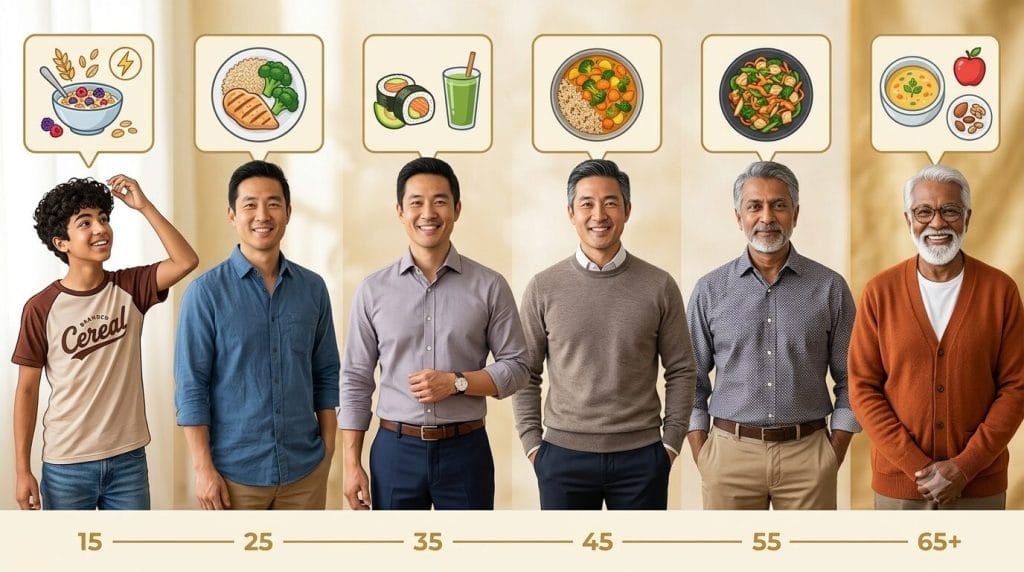

Your body's nutritional needs are not fixed. They shift meaningfully with every decade of life — driven by changes in metabolism, hormones, digestive absorption, bone density, muscle mass, and hundreds of other biological processes. The multivitamin that made sense at 20 is often the wrong choice at 50. The nutrients your body needs most in your 30s are different from what it prioritizes in your 60s. This guide walks through the specific nutritional shifts that happen in each decade of life — from ages 10 to 60+ — based on peer-reviewed research from the National Institutes of Health, the Academy of Nutrition and Dietetics, and published clinical literature. Whether you're planning for yourself or a family member, understanding these age-specific requirements is the single most important step toward long-term health.
The quick answer: how nutrient needs change by decade
Ages 10-19: Prioritize calcium, iron, and vitamin D for bone development and growth. Peak bone mass is built during this window and cannot be replicated later.
Ages 20-29: Focus on iron (especially menstruating women), B vitamins for energy metabolism, and building the nutritional habits that will define the next 60 years.
Save this article for later
Enter your email and we'll send you a direct link — no account needed.
Ages 30-39: Metabolism begins to slow. Prioritize folate (preconception health), magnesium, and B12 as absorption starts to change.
Ages 40-49: Muscle loss (sarcopenia) begins. Prioritize protein, vitamin D, calcium, and antioxidants. Hormonal shifts start.
Ages 50-59: Digestive absorption declines significantly. Prioritize B12 (sublingual forms), calcium, vitamin D, magnesium, and omega-3 EPA and DHA.
Ages 60+: Nutrient density becomes critical as appetite decreases. Prioritize B12, D, protein, omega-3, and choline for cognitive function.

What this article covers
- Ages 10-19: The bone-building decade
- Ages 20-29: The foundation decade
- Ages 30-39: The metabolic shift
- Ages 40-49: The pre-decline decade
- Ages 50-59: The absorption challenge
- Ages 60+: The density decade
- Nutrients that matter at every age
- Building a practical daily plan
- Frequently asked questions
Ages 10-19: The bone-building decade

The teenage years are the single most nutritionally important window of your life for one reason: bone development. According to the National Institutes of Health, approximately 90% of peak bone mass is achieved by age 18 in girls and age 20 in boys [1]. Bone density built during this window sets the foundation for the next 60-80 years — and cannot be replicated later in life.
What's happening biologically
The body is in an active growth phase. Height, muscle mass, organ size, and — critically — bone density are all being established. Hormone levels are surging (estrogen, testosterone, growth hormone). Nutritional demands per unit of body weight are actually higher than at any other point in adult life.
The critical nutrients for this decade
Calcium (1,300 mg/day): This is the peak calcium requirement of any life stage. Bone tissue is being actively formed. Insufficient calcium during adolescence is directly linked to increased osteoporosis risk decades later [2].
Vitamin D (600 IU/day, though many teens need more): Required for calcium absorption. Modern indoor lifestyles mean vitamin D deficiency is now common in teenagers — the NIH estimates significant deficiency rates in adolescents, particularly those with darker skin or limited sun exposure [3].
Iron (11 mg/day for boys, 15 mg/day for menstruating girls): Growing bodies need iron for expanding blood volume, and menstruating teenagers need additional iron to replace monthly losses. Iron deficiency is one of the most common nutrient deficiencies in adolescents.
Zinc, Vitamin A, and B vitamins: All critical for growth, immune function, and neural development.
What typically goes wrong
Teenage diets are notorious for being nutrient-poor. Processed foods, soft drinks (which contain phosphoric acid that impairs calcium absorption), skipped meals, and restrictive dieting all contribute to widespread nutritional gaps during this critical window.
The multivitamin question for teens
The Academy of Nutrition and Dietetics does not recommend routine multivitamin use for teenagers eating a varied diet, but acknowledges that a well-formulated teen or family multivitamin may benefit those with restricted diets (vegan, vegetarian, or eating disorders), athletes with high demands, or those with documented deficiencies. If choosing a multivitamin for this age group, look for one specifically designed for teens or families (like a properly-dosed liquid family multivitamin) — adult formulas can contain doses inappropriate for developing bodies.
Ages 20-29: The foundation decade

Your twenties are when your adult metabolism and nutritional habits are established — and when you're most likely to underappreciate how much either matters. This is the decade when many people first live independently, make their own food choices, and either build habits that will serve them for decades or accumulate nutrient debts that manifest later.
What's happening biologically
Growth is essentially complete. Bone mass typically peaks around age 25-30. Metabolism is at its lifetime peak. Hormone levels are stable. Digestive absorption is efficient. Recovery from stress, poor sleep, and dietary lapses is faster than it will ever be again.
The critical nutrients for this decade
Iron: Menstruating women need 18 mg/day — significantly higher than men (8 mg/day). Iron deficiency in women in their twenties is extremely common and often undiagnosed, contributing to fatigue, brain fog, and impaired athletic performance [4].
Folate (400 mcg/day, 600 mcg if planning pregnancy): Critical for anyone who may become pregnant. Folate deficiency in the earliest weeks of pregnancy (often before pregnancy is even known) is directly linked to neural tube defects. Every woman of childbearing age should ensure adequate folate intake.
B vitamins: Metabolism runs on B vitamins. High-energy lifestyles in the twenties often burn through B-vitamin reserves faster than diets replace them. B1, B2, B6, and B12 are all heavily involved in energy metabolism.
Calcium and vitamin D: Bone density is still being consolidated. Continued intake in the twenties helps maximize peak bone mass around age 25-30.
What typically goes wrong
The twenties are the decade of nutritional invincibility feelings. Poor sleep, alcohol, restrictive dieting, skipped meals, and processed food dominance are common — and the body seems to handle it all without complaint. The consequences accumulate quietly and only manifest a decade or two later.
The multivitamin question for the twenties
This is arguably the decade when a well-formulated multivitamin has the best long-term ROI. You're building the nutritional reserves that will support your body for the next 60 years. A comprehensive multivitamin that includes B-complex, iron (for women), folate, calcium, and vitamin D covers the most common gaps of the decade.
Ages 30-39: The metabolic shift

Something changes in your thirties, and most people notice it around age 32-35. The metabolism that let you get away with anything in your twenties starts to slow. Recovery takes longer. Body composition shifts. Nutritional needs begin their subtle but permanent transition from "supporting a growing/peaking body" to "supporting maintenance and preventing decline."
What's happening biologically
Basal metabolic rate begins to decline by roughly 1-2% per decade starting around age 30. Lean muscle mass slowly starts to decrease — a process called sarcopenia that will accelerate later. Digestive enzyme production begins a slow decline. Absorption of certain nutrients (particularly B12) becomes less efficient. Hormonal fluctuations increase for women approaching perimenopause. Testosterone levels in men begin their gradual decline.
The critical nutrients for this decade
Folate: Continues to be critical for anyone in their reproductive years. The average age of first childbirth is now in the early 30s in most developed countries.
Magnesium (310-420 mg/day): Magnesium is involved in over 300 enzymatic reactions in the body — including energy production, muscle function, and stress response. Research indicates approximately 50% of Americans are deficient in magnesium, and deficiency rates increase with age [5].
Vitamin B12: Absorption starts to become measurably less efficient in some people during their thirties, particularly those on acid-reducing medications (PPIs, H2 blockers) or with existing digestive conditions. Methylcobalamin — the active form — is preferred.
Iron (for menstruating women): Continues to be critical throughout the reproductive years.
Antioxidants (Vitamin C, E, Selenium): Cellular oxidative stress becomes more measurable in this decade. Adequate antioxidant intake supports cellular repair.
Omega-3 (EPA and DHA): Anti-inflammatory support becomes increasingly valuable as the body's natural inflammatory response starts to shift.
What typically goes wrong
People in their thirties often continue with the diet and supplement habits of their twenties, even though needs have shifted. Career pressure, parenting demands, and time constraints often push nutrition further down the priority list right when it's starting to matter more.
The multivitamin question for the thirties
A comprehensive adult multivitamin becomes genuinely valuable in this decade — one that includes bioavailable B-complex (especially methylcobalamin B12 and methylated folate), adequate vitamin D3 (typically 1,000-2,000 IU), magnesium, and iron for women. Products with additional support like The Vitamin Shots that also include EPA + DHA omega-3s and choline provide broader coverage as needs diversify.
Ages 40-49: The pre-decline decade

Your forties are the decade when the biological shifts of the thirties become impossible to ignore. Sarcopenia (age-related muscle loss) accelerates. Bone density starts to decline. Hormonal changes become significant, particularly for women approaching perimenopause. Recovery from physical exertion, illness, or dietary lapses takes noticeably longer.
What's happening biologically
Sarcopenia accelerates — adults lose approximately 3-8% of muscle mass per decade after age 40, and the rate increases with each decade [6]. Estrogen levels begin fluctuating significantly for women, often starting in their early-to-mid 40s. Testosterone in men continues its gradual decline. Digestive efficiency continues to decrease. Skin, hair, and connective tissue changes become visible. Metabolic rate continues its decline.
The critical nutrients for this decade
Protein and amino acids: Protein needs actually increase in the forties to combat sarcopenia. Research suggests adults over 40 may benefit from 1.0-1.2 g of protein per kg of body weight per day — higher than younger adults. Amino acids like leucine, lysine, and carnitine play specific roles in muscle maintenance and energy metabolism.
Vitamin D3 (2,000 IU or more): Vitamin D becomes critical for bone density, muscle function, immune health, and mood. Deficiency is very common in this age group, particularly for those with limited sun exposure. Research suggests higher doses (1,000-2,000 IU or more) may be needed to maintain adequate blood levels.
Calcium (1,000 mg/day for men, 1,200 mg/day for women over 50): Bone density starts to decline. Adequate calcium — paired with vitamin D and vitamin K — is critical.
Magnesium: Deficiency becomes more common. Supports sleep quality, which often declines in this decade.
Antioxidants: Cellular oxidative stress accelerates. Vitamin C, E, and selenium support cellular repair.
Omega-3 (EPA and DHA): Anti-inflammatory support becomes more important. Cardiovascular risk begins to become measurable.
B vitamins: Continued attention to methylated forms (methylfolate, methylcobalamin) becomes increasingly important as some people develop reduced ability to convert synthetic forms.
What typically goes wrong
Many people in their forties don't adjust their diet or supplements to match their changing biology. They continue eating and supplementing as if it's still 1998 — and wonder why energy, recovery, and body composition have all shifted.
The multivitamin question for the forties
This is the decade where a truly comprehensive daily supplement stack becomes meaningfully valuable. A high-quality multivitamin should include: bioavailable B-complex, adequate D3, magnesium, calcium (if diet is lacking), antioxidants, and ideally EPA + DHA omega-3s. Amino acid support (particularly for those active or losing muscle) becomes worth considering.
Ages 50-59: The absorption challenge

Your fifties are marked by one biological reality that changes everything: digestive absorption efficiency declines significantly. The same food, the same supplement — but less of it actually reaches your cells. This decade also brings major hormonal transitions for women (menopause) and continued gradual changes for men (andropause).
What's happening biologically
Stomach acid production (necessary for B12 absorption and mineral solubilization) declines significantly — a condition called hypochlorhydria affects a large percentage of adults over 50 [7]. Digestive enzyme production continues to decline. For women, menopause typically occurs during this decade, bringing dramatic hormonal shifts. Bone density loss accelerates without adequate calcium, D, and K intake. Cognitive changes may begin — often subtly, but measurable.
The critical nutrients for this decade
Vitamin B12 (methylcobalamin, higher doses often needed): This is the decade when B12 becomes THE most critical supplement for many people. Reduced stomach acid impairs absorption from food and standard supplements. Sublingual liquid formats bypass the acid-dependent absorption pathway and are often significantly more effective. Research suggests that adults over 50 may benefit from 100-500 mcg/day or higher, depending on absorption status [8].
Calcium (1,200 mg/day for women, 1,000 mg/day for men) and Vitamin D3 (2,000+ IU): Post-menopausal women lose bone density rapidly without adequate calcium and D. This is the last practical window to slow the decline.
Vitamin K2: Works with D3 and calcium to direct calcium to bones (and away from arteries). Becomes increasingly important for cardiovascular and bone health.
Magnesium: Deficiency continues to be common. Supports blood pressure, sleep, and muscle function.
Omega-3 EPA and DHA: Critical for cardiovascular health, cognitive function, and inflammatory balance. Research strongly supports intake in this age group.
Antioxidants and CoQ10: Natural CoQ10 production declines with age. Antioxidant needs increase.
Protein and amino acids: Sarcopenia continues. Protein needs may be 1.2-1.5 g/kg body weight for optimal muscle maintenance in this decade.
What typically goes wrong
Many people in their fifties continue taking the same standard oral multivitamin they've taken for years — not realizing that reduced stomach acid means they're absorbing significantly less of it. B12 deficiency is particularly common and often undiagnosed, contributing to fatigue, memory issues, and mood changes that get attributed to "just getting older."
The multivitamin question for the fifties
Absorption pathway becomes as important as formulation. Sublingual liquid multivitamins have a genuine advantage over tablets and capsules for this age group because they bypass the acid-dependent digestive pathway. A comprehensive formula that includes methylcobalamin B12 in adequate doses, D3, calcium, magnesium, EPA + DHA, and antioxidants — delivered in a format that actually absorbs — is meaningfully different from a generic multivitamin. Products like The Vitamin Shots that combine liquid sublingual delivery with a comprehensive formula are worth considering. For those who prefer a different delivery format, Vitamin Sprinkles offers similar coverage.
Ages 60+: The density decade

Your sixties and beyond are when nutrient density per serving becomes the single most important nutritional principle. Appetite often decreases. Food volume decreases. But nutrient requirements do not decrease proportionally — and in many cases, they actually increase. Every bite has to work harder.
What's happening biologically
Appetite regulation shifts — many older adults simply don't feel hungry as often or as strongly. Absorption of key nutrients (B12, D, calcium, magnesium, zinc) continues to decline. Muscle mass loss (sarcopenia) accelerates. Cognitive changes become more common. Immune function declines. Bone density continues its decline. Cardiovascular health becomes an active concern. Medications commonly prescribed at this age (PPIs, statins, metformin, blood pressure medications) can further impair nutrient absorption or increase specific needs.
The critical nutrients for this decade
Vitamin B12 (higher doses, ideally sublingual): B12 deficiency in adults over 60 is estimated to affect 6-15% of the population, and undiagnosed subclinical deficiency may be higher [8]. Given the neurological consequences of deficiency, adequate B12 is arguably the single most important supplement for this age group.
Vitamin D3 (2,000+ IU): Critical for bone health, immune function, muscle strength, and reducing fall risk. Older adults often need higher doses to maintain adequate blood levels.
Protein and amino acids: Sarcopenia is a major health threat in this age group. Adequate protein intake (often 1.2-1.6 g/kg body weight) combined with resistance training is the single most important intervention for maintaining independence.
Choline: Cognitive function support becomes critical. Choline is a precursor to acetylcholine, a neurotransmitter essential for memory and cognition. Research indicates over 90% of adults fall short of adequate choline intake, and this may be particularly problematic in older populations [9].
Omega-3 EPA and DHA: Strong research supports adequate intake for cardiovascular health, cognitive function, and eye health (macular degeneration prevention).
Calcium, Magnesium, Vitamin K2: All critical for continued bone health and cardiovascular support.
Antioxidants: Vitamin C, E, selenium, and CoQ10 all support cellular health.
What typically goes wrong
Older adults often reduce their intake of nutrient-dense foods, either due to reduced appetite, dental issues, cost, or difficulty preparing meals. Combined with reduced absorption, this creates a compounding nutritional gap. Standard multivitamins may not provide adequate doses given absorption challenges.
The multivitamin question for 60+
This age group benefits most from a comprehensive, high-density daily supplement that delivers meaningful doses of the most critical nutrients — in a format that actually absorbs. Liquid formats offer real advantages here. Higher-dose B12, D3, choline, EPA + DHA, and adequate protein intake (usually from food but supplemented if needed) form the foundation of good nutrition in this decade.
Nutrients that matter at every age

While specific priorities shift by decade, some nutrients matter throughout life:
- Vitamin B12: Critical at every age, but especially after 50. Deficiency has permanent neurological consequences.
- Vitamin D3: Roughly 41% of American adults are deficient regardless of age [3]. Testing and supplementing based on blood levels is smart at any age.
- Omega-3 EPA and DHA: Essential fatty acids the body cannot make. Important for brain, heart, and eye health across all ages.
- Iron: Needs vary dramatically by age and sex — but iron status matters throughout life.
- Magnesium: Involved in over 300 enzymatic reactions. Deficiency is common at every adult age.
- Adequate protein and complete amino acid intake: Foundational at every stage of life.
Building a practical daily plan by decade

Here's a decade-by-decade framework for building a practical nutrition plan:
The universal foundation (all ages)
- Base your diet on whole foods: vegetables, fruits, whole grains, quality protein sources, healthy fats
- Get vitamin D through some sun exposure and/or supplementation
- Test blood levels of key nutrients (B12, D, ferritin) at least every 2-3 years
- Adjust intake based on actual data, not guesses
Ages 10-19 practical stack
- Focus on nutrient-dense meals with dairy, leafy greens, quality protein
- Family-friendly multivitamin if diet is restricted
- Vitamin D3 if sun exposure is limited
- Iron supplementation only if tested and confirmed deficient
Ages 20-29 practical stack
- Comprehensive adult multivitamin with B-complex, iron (women), folate, D3
- Establish blood testing habit (annually)
- Address any deficiencies before they compound over decades
Ages 30-39 practical stack
- Comprehensive adult multivitamin with methylated B-complex forms
- Adequate D3 (1,000-2,000 IU) based on blood levels
- Magnesium supplementation if diet is inadequate
- Omega-3 EPA and DHA (from a multivitamin that includes them or a separate algal supplement)
Ages 40-49 practical stack
- Comprehensive multivitamin optimized for adult needs
- D3 at 2,000+ IU based on blood levels
- Protein intake attention (1.0-1.2 g/kg body weight)
- Magnesium, calcium if diet is inadequate
- Omega-3 EPA and DHA
- Consider adding amino acid support for muscle maintenance
Ages 50-59 practical stack
- Liquid or sublingual multivitamin for better absorption
- Higher-dose B12 (methylcobalamin) — 100+ mcg
- D3 at 2,000+ IU based on blood levels
- Calcium + K2 for bone and cardiovascular health
- Omega-3 EPA and DHA
- Protein intake attention (1.2-1.5 g/kg body weight)
- Consider CoQ10 supplementation, especially if on statins
Ages 60+ practical stack
- Comprehensive liquid multivitamin (better absorption)
- Higher-dose B12 (methylcobalamin) — 250+ mcg
- D3 based on blood levels (often 2,000-4,000 IU)
- Calcium + K2 for bone and cardiovascular health
- Omega-3 EPA and DHA
- Choline supplementation for cognitive support
- Protein-focused eating (1.2-1.6 g/kg body weight)
- Regular blood work to monitor status
Explore the full product line at thevitaminshots.com for comprehensive multivitamin options across life stages.
Frequently asked questions
Do I really need to change my multivitamin as I age?
The evidence strongly suggests yes. Digestive absorption changes significantly with age, hormonal shifts alter nutrient needs, and specific requirements (calcium, B12, D, protein) increase or shift in ways that a generic adult multivitamin often doesn't address. The multivitamin that worked at 25 is often not optimal at 55.
What's the biggest nutritional mistake people make in each decade?
In the teens: skipping calcium and D during peak bone building. In the twenties: assuming metabolism will always compensate for poor diet. In the thirties: not adjusting to slowing metabolism and increased hormonal complexity. In the forties: ignoring the sarcopenia warning signs. In the fifties: continuing standard oral supplements despite reduced absorption. In the sixties+: reducing food intake without increasing nutrient density.
Should I get blood work to guide my supplementation?
Yes, particularly for vitamin D (25-hydroxyvitamin D), B12 (holotranscobalamin or methylmalonic acid for accuracy), and iron (ferritin). These three tests alone can guide the most important supplementation decisions. Testing every 2-3 years in your 20s-40s and annually from your 50s onward is a reasonable framework.
Are liquid multivitamins really better as I age?
The evidence suggests yes for adults over 50, primarily because of reduced stomach acid. Liquid formats enable partial sublingual absorption that bypasses the acid-dependent digestive pathway. For adults under 40 with normal digestion, the difference between a quality liquid and a quality tablet may be smaller. But for anyone with reduced stomach acid, on PPIs, or over 50, liquid formats offer real absorption advantages.
Can teenagers take adult multivitamins?
Generally not recommended. Adult multivitamins can contain iron or vitamin doses that are inappropriate for developing bodies. A teen or family-formulated multivitamin (typically with age-graduated dosing) is safer. If a teen has specific documented deficiencies, targeted supplementation under medical guidance is appropriate.
Which nutrients are most commonly deficient at each age?
Teens: calcium, D, iron. Twenties: iron (women), folate, B12. Thirties: magnesium, D, B12. Forties: D, magnesium, protein, omega-3. Fifties: B12, D, calcium, omega-3. Sixties+: B12, D, protein, omega-3, choline.
Does menopause change nutrient needs significantly?
Yes, meaningfully. Post-menopausal women lose bone density more rapidly and need more calcium and D. Iron needs decrease (no menstruation), but overall nutrient absorption may decline. Omega-3 and antioxidant support become more important for cardiovascular health. Hot flashes and mood changes may respond to adequate magnesium and B-complex.
Do men and women need different multivitamins by decade?
Under 50, yes — primarily due to iron needs (menstruating women need much more, adult men generally need less than the standard multivitamin dose). Over 50, the differences shrink but remain — post-menopausal women need more calcium; men may benefit from prostate-supportive nutrients. Most quality comprehensive multivitamins can serve both sexes if iron is appropriately dosed.
What role do prescription medications play?
Significant. PPIs and H2 blockers impair B12 and mineral absorption. Metformin depletes B12. Statins deplete CoQ10. Diuretics may deplete magnesium and potassium. Anyone on long-term medications should discuss nutritional support with their doctor and pharmacist — this is where a PharmD consultation can be valuable.
Can I skip supplements if I eat a really good diet?
Partially yes, partially no. A well-planned diet can meet most needs at younger ages. But B12 (impossible from unfortified plant foods, hard to absorb after 50), D (limited food sources for most people), and omega-3 EPA and DHA (very limited plant sources) are gaps that persist even with excellent diets. As you age, absorption declines make dietary sufficiency harder even for excellent eaters.
References & sources
- National Institutes of Health, NIH Osteoporosis and Related Bone Diseases National Resource Center. Bone Mass Measurement: What the Numbers Mean. bones.nih.gov
- Weaver CM, Gordon CM, Janz KF, et al. The National Osteoporosis Foundation's position statement on peak bone mass development and lifestyle factors. Osteoporosis International. 2016;27(4):1281-1386.
- National Institutes of Health, Office of Dietary Supplements. Vitamin D — Fact Sheet for Health Professionals. ods.od.nih.gov
- National Institutes of Health, Office of Dietary Supplements. Iron — Fact Sheet for Health Professionals. ods.od.nih.gov
- DiNicolantonio JJ, O'Keefe JH, Wilson W. Subclinical magnesium deficiency: a principal driver of cardiovascular disease and a public health crisis. Open Heart. 2018;5(1):e000668.
- Volpi E, Nazemi R, Fujita S. Muscle tissue changes with aging. Current Opinion in Clinical Nutrition and Metabolic Care. 2004;7(4):405-410.
- Feldman M, Barnett C. Fasting gastric pH and its relationship to true hypochlorhydria in humans. Digestive Diseases and Sciences. 1991;36(7):866-869.
- National Institutes of Health, Office of Dietary Supplements. Vitamin B12 — Fact Sheet for Health Professionals. ods.od.nih.gov
- Wallace TC, Fulgoni VL. Assessment of Total Choline Intakes in the United States. Journal of the American College of Nutrition. 2016;35(2):108-112.
- Academy of Nutrition and Dietetics. Position of the Academy of Nutrition and Dietetics: Nutrition and Healthy Eating for Older Adults. Journal of the Academy of Nutrition and Dietetics.
- National Institutes of Health, Office of Dietary Supplements. Calcium — Fact Sheet for Health Professionals. ods.od.nih.gov
- National Institutes of Health, Office of Dietary Supplements. Magnesium — Fact Sheet for Health Professionals. ods.od.nih.gov
.png)