
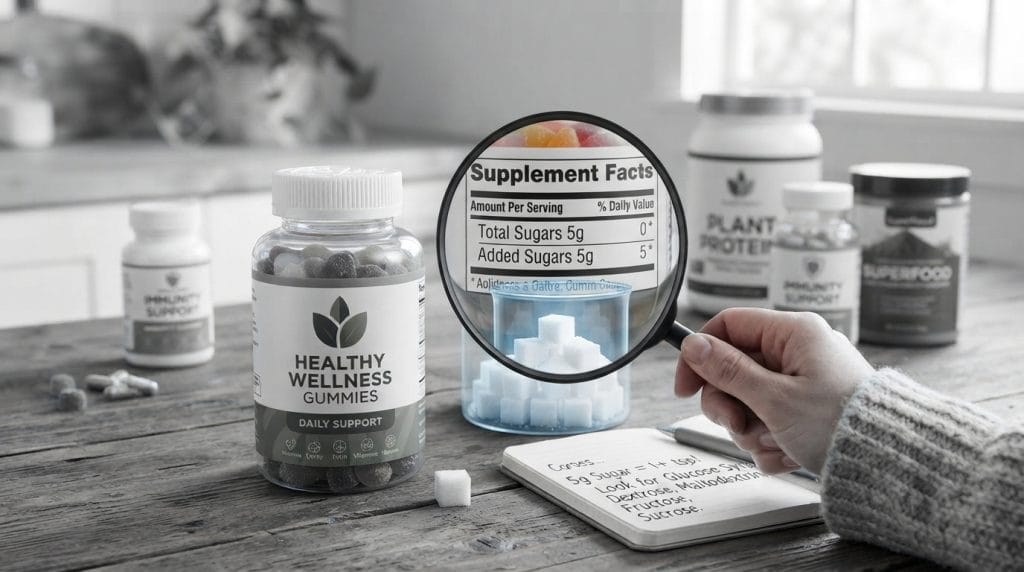
Walk down any supplement aisle and you'll see the word "healthy" attached to products that quietly contain more sugar than a candy bar per serving. Gummy vitamins, "wellness" drink mixes, flavored protein powders, and even some multivitamins marketed as clean or natural routinely hide added sugars behind label terms most people don't recognize. This isn't a conspiracy — it's a labeling loophole most consumers have never been taught to spot. This guide breaks down exactly where hidden sugar shows up in the supplement industry, the 15+ ingredient names sugar hides behind on a label, why gummy vitamins are the biggest offender, and how to actually read a Supplement Facts panel like someone who knows what they're looking at.
The quick answer: where sugar hides in supplements
Gummy vitamins are the single biggest source of hidden sugar in the supplement industry — a typical adult gummy vitamin serving (2-4 gummies) can contain 2-8 grams of added sugar, and many brands require 2-3 servings to hit the labeled dose, multiplying that sugar intake.
Sugar hides behind more than 15 different label names including cane syrup, tapioca syrup, corn syrup, dextrose, maltodextrin, fruit juice concentrate, and "organic sugar" — all of which function identically to regular table sugar in the body.
Save this article for later
Enter your email and we'll send you a direct link — no account needed.
The fix: check the Supplement Facts panel's "Total Sugars" line directly rather than trusting front-of-package claims like "natural" or "made with real fruit," and consider sugar-free liquid or capsule formats if daily sugar intake matters to you.
What this article covers
- Why supplement companies add sugar in the first place
- The gummy vitamin sugar problem, with real numbers
- 15+ names sugar hides behind on a label
- Where else hidden sugar shows up
- Why hidden sugar in supplements actually matters
- How to read a Supplement Facts panel like a pro
- 5 marketing phrases that often signal hidden sugar
- What sugar-free supplement formats look like
- Frequently asked questions
Why supplement companies add sugar in the first place
Sugar isn't in most supplements by accident — it's there because of two very practical manufacturing and business reasons.
Reason 1: Taste masking
Many active nutrients taste genuinely unpleasant in their raw form. B vitamins can taste bitter or metallic. Minerals like zinc and magnesium have a chalky, mineral taste. Certain amino acids and herbal extracts taste bitter enough that most people wouldn't tolerate them without heavy sweetening. Sugar (and its many aliases) is the cheapest, most effective way to mask these tastes at scale.
Reason 2: Gummy format requires it structurally
Gummy vitamins are not simply "vitamins in candy form" as a marketing gimmick — the gummy format actually requires sugar or sugar alcohols as a structural and preservation ingredient. Corn syrup, sucrose, and similar ingredients aren't just for taste in a gummy; they're part of what gives the gummy its chewy texture and helps preserve it on the shelf. This is a big part of why gummy vitamins are structurally almost incapable of being truly low-sugar.
Reason 3: Consumer preference and repeat purchases
Sweetened products simply taste better to most people, which drives brand loyalty and repeat purchases. A supplement company optimizing for retention has a direct incentive to make the product taste more like a treat than medicine — even when marketed as a "clean" or "natural" wellness product.
The gummy vitamin sugar problem, with real numbers

Gummy vitamins are consistently the single largest source of hidden sugar in the supplement aisle, and the numbers are worth seeing directly.
What a typical serving actually contains
Across a range of popular adult gummy multivitamin brands, published Supplement Facts panels show:
- 2 grams of added sugar per gummy is common for many mainstream brands
- Most adult gummy multivitamins require 2-4 gummies per serving to deliver the labeled nutrient dose
- This means many people consume 4-8 grams of added sugar daily from their "healthy" multivitamin alone — before counting any other sugar in their diet
- Children's gummy vitamins often contain proportionally similar or higher sugar-to-nutrient ratios, since the gummy base doesn't scale down as easily as the nutrient dose does
For context, the American Heart Association recommends limiting added sugar intake to no more than 25 grams per day for women and 36 grams per day for men [1]. A gummy vitamin habit alone can represent 15-30% of that entire daily allowance — from a product explicitly marketed as supporting health.
Why gummies need more sugar than you'd expect
Unlike a flavored drink where sugar is purely for taste, gummy candy chemistry requires specific ratios of sugar, corn syrup, and gelatin (or pectin for vegan versions) to achieve the right chew texture, shelf stability, and mouthfeel. Reducing sugar content significantly changes the product's texture and shelf life — which is why "sugar-free" gummy vitamins are rare, and the ones that exist typically rely on sugar alcohols (which carry their own digestive caveats, covered below) rather than being truly sugar-free in the everyday sense.
The "just one gummy" marketing trick
Some brands market "just take one gummy" language prominently, while the actual Supplement Facts panel reveals that one gummy only provides a fraction of the labeled nutrient doses — with the full label claim requiring 2, 3, or 4 gummies. Always check the "servings per container" and "serving size" lines together, not just the front-of-package claim.
15+ names sugar hides behind on a supplement label
Sugar rarely appears on an ingredient list as simply "sugar." Manufacturers have dozens of alternative names — some because they're using a genuinely different sweetener, others because alternative names sound more "natural" to consumers even though they behave identically to sugar in the body. Here are the most common names to watch for:
Sugars that function identically to table sugar
- Cane sugar / cane syrup / evaporated cane juice — chemically identical to white sugar, marketed as more "natural"
- Organic sugar — still sugar; organic certification does not change the metabolic impact
- Dextrose — a simple sugar chemically identical to glucose
- Sucrose — the scientific name for common table sugar
- Corn syrup / high fructose corn syrup — common in gummy formulations for texture
- Tapioca syrup — increasingly common in "natural" branded gummies, functions as sugar
- Brown rice syrup — marketed as a wholesome alternative, still a concentrated sugar
- Maltodextrin — technically a complex carbohydrate but digests almost as fast as pure sugar and is often used as a filler/sweetener
- Fruit juice concentrate — stripped of fiber, behaves like added sugar despite "fruit" branding
- Agave nectar / agave syrup — marketed as low-glycemic, but very high in fructose and still an added sugar
- Honey — a natural product, but nutritionally and metabolically still classified as added sugar when used as a sweetener in a manufactured product
- Maple syrup — same principle as honey; natural origin doesn't change the sugar classification
- Molasses — a byproduct of sugar refining, still classified as added sugar
- Fructose — a simple sugar, sometimes marketed as "fruit sugar"
- Glucose syrup — common industrial sweetener

Sugar alcohols (different category, different caveats)
Some "sugar-free" gummies use sugar alcohols instead of true sugar. These don't count as "added sugars" on the label the same way, but they come with their own trade-off:
- Sorbitol, xylitol, maltitol, erythritol — lower glycemic impact than sugar, but commonly cause digestive discomfort (bloating, gas, or laxative effect) at the doses used in gummy vitamins, particularly maltitol and sorbitol
Sugar alcohols aren't inherently "bad," but a product isn't automatically a clean win just because it swapped sugar for a sugar alcohol — read the full ingredient list and understand what you're actually getting.
Where else hidden sugar shows up in the wellness aisle

Gummy vitamins get most of the attention, but hidden sugar shows up across several supplement categories that people don't expect:
Flavored electrolyte and hydration powders
Many "wellness hydration" mixes marketed for recovery or energy contain meaningful added sugar per serving — often in the 8-15 gram range — despite health-focused branding and packaging.
Flavored protein powders and meal replacements
"Natural flavor" and "clean protein" claims don't guarantee low sugar. Some flavored protein powders, particularly those targeting taste over macros, carry 6-12 grams of added sugar per scoop.
Pre-workout and energy supplement drink mixes
Marketed around performance rather than nutrition, many of these products use sugar heavily for flavor and a quick energy spike, sometimes exceeding 15 grams per serving.
"Wellness shot" beverages
Small bottled wellness shots (ginger, turmeric, immunity blends) frequently use fruit juice concentrate as their primary sweetening agent — technically "made with real fruit," but functioning as concentrated added sugar once the fiber has been removed during processing.
Children's chewable vitamins
Often the least scrutinized category by parents, since "it's for kids, it must be fine" — but children's chewable and gummy vitamins can carry proportionally high sugar content relative to body weight and typical nutrient needs.
Why hidden sugar in supplements actually matters
A few grams of sugar from a vitamin might seem trivial compared to a soda or dessert — but the concern isn't really about any single serving. It's about three compounding factors.
1. It's sugar you didn't account for
Most people mentally track sugar from obvious sources — desserts, soda, candy — but don't think to count their "healthy" supplement toward their daily total. This creates a blind spot in otherwise careful eating habits.
2. It compounds with other "healthy" hidden sugar sources
Flavored yogurt, granola bars, "natural" sodas, and gummy vitamins are frequently consumed by the same health-conscious person in the same day — each contributing a few grams that don't individually seem significant but add up across a day, a week, and a year.
3. It undermines the actual health goal
Someone taking a multivitamin specifically to support their health is, in the case of many gummy formats, simultaneously consuming meaningful daily added sugar as an unavoidable side effect of the delivery format — working somewhat against their own stated goal.
What the research says about added sugar generally
The Dietary Guidelines for Americans recommend limiting added sugars to less than 10% of total daily calories [2]. Research published in JAMA Internal Medicine found that higher added sugar consumption is associated with increased cardiovascular disease mortality risk, independent of body weight [3]. While a single gummy vitamin serving is unlikely to be the deciding factor in someone's health outcome, unaccounted daily sugar from "health" products is a real and measurable contributor to total intake that most consumers aren't tracking.
How to read a Supplement Facts panel like someone who knows what they're looking at
Reading past the marketing requires looking at three specific parts of the label, in this order:
Step 1: Find "Total Sugars" on the Supplement Facts panel
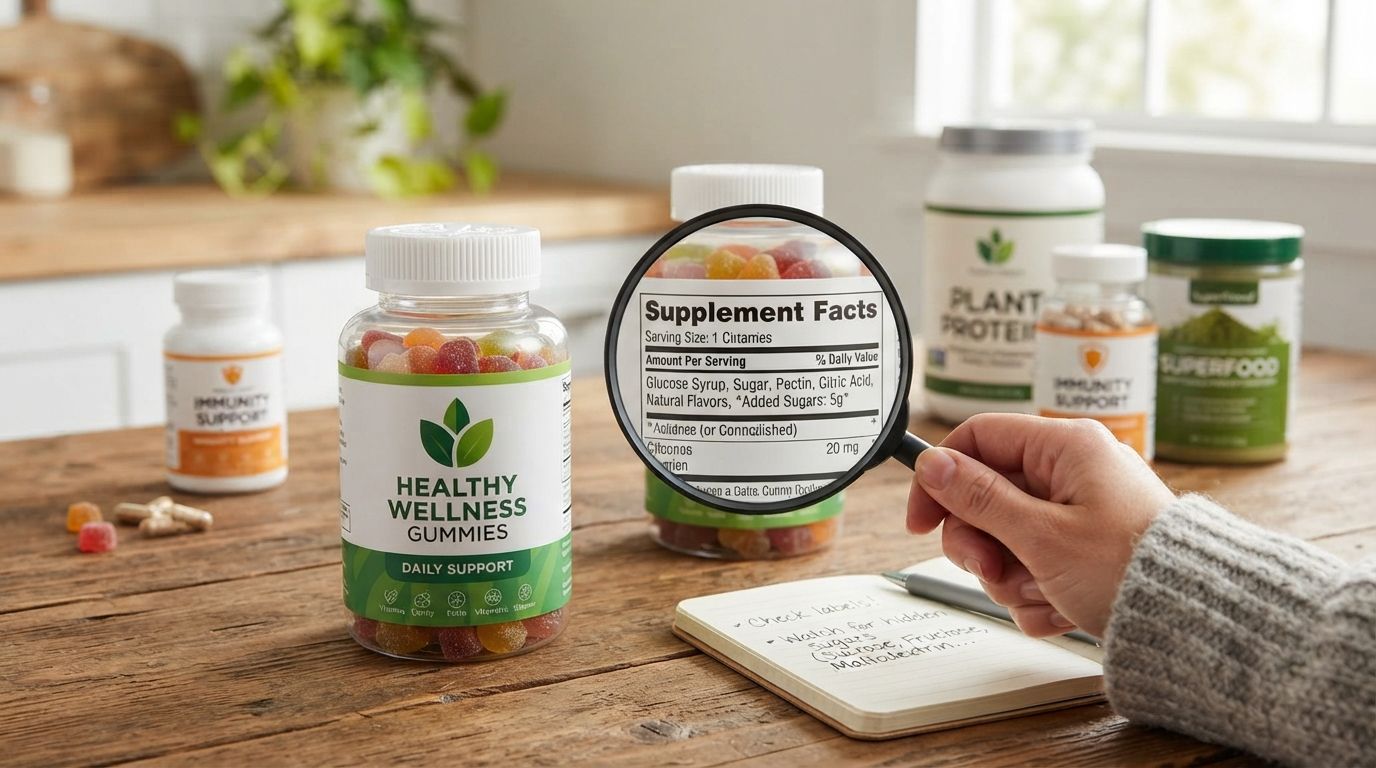
By law, U.S. Supplement Facts panels must list "Total Sugars" and, in most cases, "Includes X g Added Sugars" as a sub-line. This is the single most reliable number — ignore front-of-package claims entirely and go straight to this line.
Step 2: Check serving size against the marketing claim
If the front label says "1 gummy a day" but the Supplement Facts panel lists "Serving Size: 2 gummies," the marketed sugar-per-gummy figure is misleading you by roughly half. Always match the sugar figure to the ACTUAL serving size needed for the full labeled dose.
Step 3: Scan the ingredient list for the 15+ sugar aliases above
Ingredients are listed by weight, from most to least. If any sugar alias appears in the first 3-5 ingredients, sugar is a structurally significant part of that product — not an incidental trace addition.
Step 4: Ignore front-of-package health halos
Terms like "natural," "made with real fruit," "no high fructose corn syrup," and "organic" do not mean low sugar or no added sugar. A product can be technically accurate on all of these claims while still containing 6+ grams of added sugar per serving.
5 marketing phrases that often signal hidden sugar
None of these phrases are illegal or necessarily dishonest — but each one is commonly used on products that also contain meaningful added sugar. Treat them as a prompt to check the label, not as a guarantee either way.
- "Made with real fruit" — often refers to fruit juice concentrate, which behaves as added sugar once fiber is removed
- "No high fructose corn syrup" — frequently means the product uses a different sugar (cane sugar, tapioca syrup) instead, not less sugar overall
- "Naturally sweetened" — honey, agave, and maple syrup are all "natural," and all function as added sugar metabolically
- "Just one gummy a day" — check whether the Supplement Facts panel actually requires more than one gummy for the full labeled dose
- "Organic sugar" or "organic cane sugar" listed early in ingredients — organic certification addresses farming practice, not metabolic impact
What sugar-free supplement formats actually look like

If minimizing added sugar in your supplement routine matters to you, format choice makes a real difference:
Capsules and tablets
Generally the lowest-sugar format by default, since they don't rely on sugar for texture or palatability the way gummies do. Always still check the label — some chewable tablets add sugar for taste.
Unflavored or naturally flavored liquid formats
Liquid supplements can be formulated without added sugar, using natural flavor extracts and, where sweetness is needed, non-sugar sweeteners like stevia or monk fruit rather than caloric sugars. Always verify by checking the Supplement Facts panel directly, since "liquid" alone doesn't guarantee sugar-free.
Powder formats mixed into food or water
Unflavored powders offer the most control, since you're not relying on the manufacturer's sweetening choices at all. Flavored powders should be checked the same way as any other category.
What to actually check regardless of format
Regardless of format, the "Total Sugars" line on the Supplement Facts panel remains the single source of truth. A liquid or capsule marketed as "sugar-free" should show 0g on that line — if it doesn't, the claim likely refers to "no added cane sugar" while still using another caloric sweetener.
The Vitamin Shots is formulated sugar-free across its liquid product line, using the Supplement Facts panel disclosure standard described above rather than relying on front-of-package claims alone. Explore the full Vitamin Shots product line, including Vitamin Sprinkles, at thevitaminshots.com.
Frequently asked questions
How much sugar is actually in a typical gummy vitamin?
Many popular adult gummy multivitamins contain around 2 grams of added sugar per gummy, and most brands require 2-4 gummies per serving to deliver the full labeled nutrient dose — meaning a typical daily serving can contain 4-8 grams of added sugar. Always check the specific brand's Supplement Facts panel, since formulations vary.
Is "organic sugar" healthier than regular sugar in a supplement?
No, not metabolically. Organic certification reflects farming and processing standards, not how the sugar behaves in your body. Organic cane sugar has the same glycemic and caloric impact as conventional sugar.
Are sugar alcohols in "sugar-free" gummies a good alternative?
They have a lower glycemic impact than sugar and don't count as "added sugar" on the label, which is a genuine benefit. However, sugar alcohols like maltitol and sorbitol commonly cause digestive discomfort — bloating, gas, or a laxative effect — particularly at the doses used in gummy vitamins. They're a trade-off, not a free win.
Why do gummy vitamins need sugar specifically, rather than another ingredient?
Gummy candy texture depends on specific ratios of sugar (or sugar substitutes), gelling agents like gelatin or pectin, and moisture content to achieve the right chew and shelf stability. This is a structural requirement of the format, not purely a flavor choice — which is why truly sugar-free gummies are difficult to formulate well.
Does "made with real fruit" mean a supplement is low in sugar?
Not necessarily. This phrase often refers to fruit juice concentrate, which has had its fiber removed during processing. Without fiber, fruit juice concentrate is metabolized very similarly to added sugar, even though it originated from fruit.
How do I quickly check if a supplement has hidden sugar?
Go directly to the Supplement Facts panel and find the "Total Sugars" line (and "Includes X g Added Sugars" if listed separately). This number is regulated and standardized, unlike front-of-package marketing claims. Also check that the serving size on the label matches what's actually needed for the full nutrient dose, since some products understate sugar per gummy by listing it per single gummy when 2-4 are required daily.
Are children's gummy vitamins worse for hidden sugar than adult ones?
They can be proportionally similar or higher, since the gummy base doesn't scale down as easily as the nutrient dose. Parents should check the Supplement Facts panel on children's products with the same scrutiny as adult products, rather than assuming child-marketed products are automatically lower in sugar.
Is liquid or capsule format guaranteed to be sugar-free?
No format guarantees zero added sugar automatically — always check the label. However, capsules, tablets, and unflavored liquids or powders are structurally less dependent on sugar than gummies, since they don't need sugar for texture or shelf stability the way gummy candy does.
How much added sugar is considered acceptable per day?
The American Heart Association recommends no more than 25 grams of added sugar per day for women and 36 grams per day for men. The Dietary Guidelines for Americans recommend limiting added sugars to less than 10% of total daily calories. A gummy vitamin habit contributing 4-8 grams daily can represent a meaningful percentage of that total before any other food sources are counted.
Why would a supplement company use sugar aliases instead of just saying "sugar"?
Ingredient lists are legally required to use the specific technical or common name of each ingredient (such as "dextrose" or "cane syrup"), so this isn't necessarily deceptive labeling in a legal sense. However, the practical effect is that most consumers don't recognize these terms as sugar, which is why understanding the full list of aliases is genuinely useful for informed label reading.
References & sources
- American Heart Association. Added Sugars and Cardiovascular Disease Risk. heart.org
- U.S. Department of Agriculture and U.S. Department of Health and Human Services. Dietary Guidelines for Americans, 2020-2025. dietaryguidelines.gov
- Yang Q, Zhang Z, Gregg EW, et al. Added sugar intake and cardiovascular diseases mortality among US adults. JAMA Internal Medicine. 2014;174(4):516-524.
- U.S. Food and Drug Administration. Food Labeling: Revision of the Nutrition and Supplement Facts Labels. Federal Register. fda.gov
- U.S. Food and Drug Administration. Added Sugars on the New Nutrition Facts Label. fda.gov
- Mäkinen KK. Sugar alcohols, caries incidence, and remineralization of caries lesions: a literature review. International Journal of Dentistry. 2010;2010:981072.
- Livesey G. Health potential of polyols as sugar replacers, with emphasis on low glycaemic properties. Nutrition Research Reviews. 2003;16(2):163-191.
.png)