
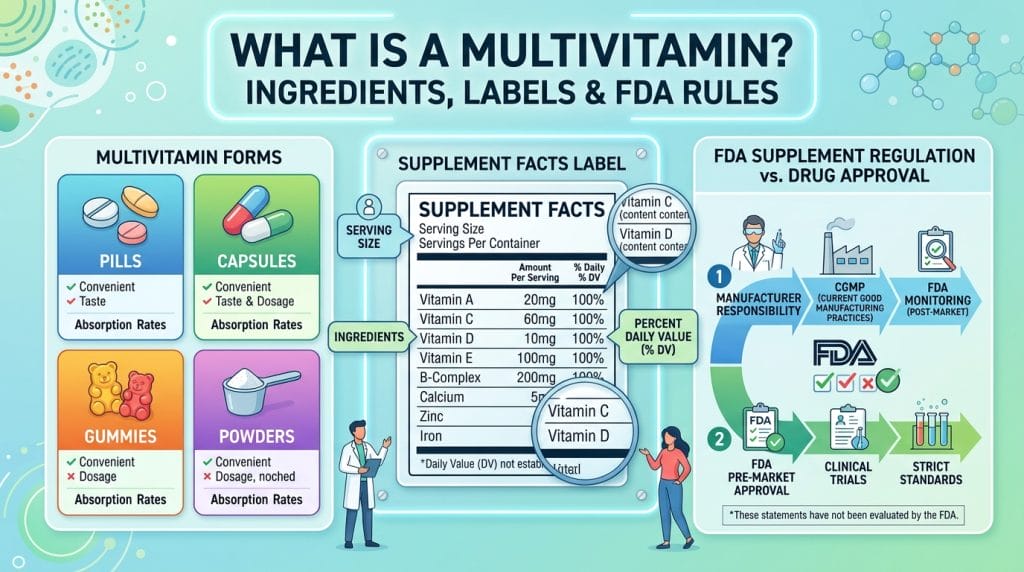
A multivitamin is a supplement that combines multiple vitamins and minerals — typically 10 to 30+ nutrients — into a single daily dose, designed to fill gaps between what a person eats and what their body needs. Multivitamins are regulated in the United States as dietary supplements, not drugs, which means the FDA does not approve them for safety or effectiveness before they reach the market the way it does with medications. They come in tablet, capsule, softgel, gummy, powder, and liquid forms, and formulations vary enormously between brands in both the nutrients included and the doses provided.

"Multivitamin" sounds like it should mean one standardized thing — a defined product with a defined set of ingredients at defined doses. It doesn't. The term is a loose, largely unregulated category name, and two products both labeled "multivitamin" can differ enormously: one might contain 10 nutrients, another 35; one might use synthetic isolated nutrients, another whole-food-derived compounds; one might be designed for children, another for post-menopausal women. This guide breaks down what a multivitamin legally and practically is, how the industry actually regulates (and doesn't regulate) them, what's typically inside one, how to read a label correctly, and how to evaluate whether a specific product is well-formulated for your needs.
What this article covers
- How multivitamins are actually regulated
- What's typically inside a multivitamin
- The different types and formats of multivitamins
- Nutrient forms: why the same vitamin isn't always the same ingredient
- How to read a Supplement Facts label correctly
- RDA, DV, and %DV: what the numbers on the label actually mean
- Who actually needs a multivitamin, according to research
- How to evaluate whether a specific multivitamin is well-formulated
- Frequently asked questions
How multivitamins are actually regulated

In the United States, multivitamins fall under the Dietary Supplement Health and Education Act (DSHEA) of 1994, which classifies vitamins, minerals, herbs, amino acids, and similar products as "dietary supplements" — a distinct legal category from both foods and drugs [1].
Save this article for later
Enter your email and we'll send you a direct link — no account needed.
What this means in practice
- No pre-market approval required: Unlike prescription or over-the-counter drugs, supplement manufacturers do not need FDA approval before selling a multivitamin. The manufacturer is responsible for ensuring the product is safe and that label claims are truthful, but the FDA does not verify this before the product reaches shelves.
- The FDA can act after the fact: The FDA has authority to remove a supplement from the market if it's found to be unsafe or mislabeled after it's already being sold, but this is reactive rather than preventive oversight.
- Good Manufacturing Practice (GMP) requirements do apply: Supplement manufacturers are required to follow specific manufacturing quality standards, which cover things like ensuring the product actually contains what the label states, is not contaminated, and is manufactured under sanitary conditions.
- Health claims are restricted, structure/function claims are allowed: A multivitamin cannot legally claim to "treat," "cure," or "prevent" a disease. It can make "structure/function" claims like "supports immune health" or "supports energy metabolism," which is why supplement marketing language sounds the way it does.
What third-party certifications actually add
Because government pre-market testing doesn't exist for supplements, third-party certification programs (NSF International, USP, Non-GMO Project, Clean Label Project, and others) have emerged specifically to independently verify that a product contains what it claims and is free from specific contaminants. These certifications are voluntary and paid for by the manufacturer, but they represent a genuine independent verification layer that the base regulatory system doesn't provide.
What's typically inside a multivitamin

While formulations vary enormously, most multivitamins draw from a common pool of ingredient categories:
Water-soluble vitamins
The B-complex vitamins (B1/thiamine, B2/riboflavin, B3/niacin, B5/pantothenic acid, B6, B7/biotin, B9/folate, B12) and vitamin C. These dissolve in water, are generally not stored long-term in the body, and carry a lower toxicity risk at high doses since excess is typically excreted in urine.
Fat-soluble vitamins
Vitamins A, D, E, and K. These are stored in fat tissue and the liver, which means they carry a higher toxicity risk at very high doses compared to water-soluble vitamins, since the body cannot excrete excess as readily.
Minerals
Commonly included minerals are calcium, magnesium, zinc, iron, iodine, selenium, copper, manganese, chromium, and molybdenum. Not every multivitamin includes all of these — many deliberately exclude iron (particularly men's and senior formulas) or calcium (particularly minimalist formulas) based on specific target-audience needs.
What's often missing, even in comprehensive formulas
Omega-3 fatty acids (EPA and DHA), choline, and specific amino acids are frequently absent from even fairly comprehensive multivitamins, since they are structurally harder to formulate into a single tablet or capsule alongside dozens of other ingredients. This is one of the more consistent gaps across the multivitamin category broadly.
The different types and formats of multivitamins

Multivitamins are typically categorized along two independent dimensions: delivery format and target demographic.
By delivery format
- Tablets: The most common and typically least expensive format. Requires digestion and adequate stomach acid to break down.
- Capsules and softgels: Often dissolve slightly faster than compressed tablets, and softgels are commonly used for fat-soluble vitamins suspended in oil.
- Gummies: Chewable, generally more palatable, but typically require added sugar or sugar alcohols for texture, and dosing per gummy is often lower than tablet or capsule formats, requiring multiple gummies for a full serving.
- Powders: Mixed into water or food, allow for larger doses of any given nutrient than a tablet could physically hold.
- Liquids: Can offer partial sublingual (under-the-tongue) absorption for some nutrients, which bypasses part of the digestive process — potentially useful for people with reduced stomach acid or absorption difficulties.
By target demographic
- Children's/family formulas: Age-graduated dosing, typically exclude iron and high-dose minerals for safety, often flavored for palatability.
- Men's formulas: Frequently exclude or minimize iron (since most adult men don't need supplemental iron), sometimes include prostate-supportive ingredients.
- Women's formulas: Often include iron (for menstrual losses) and higher folate (for reproductive-age women), sometimes include additional calcium.
- Prenatal formulas: Specifically formulated with higher folate, iron, and choline for pregnancy-specific needs.
- Senior formulas: Often feature higher B12 doses (accounting for age-related absorption decline) and typically exclude or minimize iron.
Nutrient forms: why the same vitamin isn't always the same ingredient

One of the least understood aspects of multivitamins is that a single nutrient, like "B12" or "folate," can appear on a label in multiple different chemical forms — and these forms are not interchangeable in how the body processes them.
Common examples
- Vitamin B12: Methylcobalamin (the naturally active form) vs cyanocobalamin (a synthetic form requiring conversion in the body)
- Folate: Methylfolate/L-5-MTHF (active form) vs folic acid (synthetic form requiring enzymatic conversion, which some people do less efficiently due to genetic variation)
- Vitamin D: D3/cholecalciferol (more effective at raising blood levels) vs D2/ergocalciferol (less effective, though plant-derived)
- Iron: Various forms including ferrous fumarate, ferrous sulfate, and iron bisglycinate, which differ in absorption efficiency and digestive tolerability
- Magnesium: Forms like citrate, glycinate, and oxide differ significantly in absorption rate and digestive side effects
The specific form used matters for both bioavailability (how well the body can actually use it) and, for some people, individual tolerance or genetic factors affecting metabolism. Checking the specific form listed on a Supplement Facts panel — not just the nutrient name — is a meaningful part of evaluating formulation quality.
How to read a Supplement Facts label correctly

Every legally sold dietary supplement in the U.S. must include a standardized Supplement Facts panel, distinct from the Nutrition Facts panel used on food products. Reading it correctly involves checking several specific elements:
- Serving size: Confirm how many tablets, capsules, or gummies constitute one "serving," since front-of-package marketing sometimes references a smaller unit than what's actually needed for the full labeled dose.
- Amount per serving: The actual quantity of each nutrient (in mg, mcg, or IU) included.
- %DV (Percent Daily Value): Shows what percentage of the general daily recommendation that amount represents — covered in more detail in the next section.
- Nutrient form: Listed in parentheses next to the nutrient name (e.g., "Vitamin B12 (as Methylcobalamin)") — this is where the specific chemical form is disclosed.
- Other ingredients: Listed below the main nutrient table, this includes fillers, binders, capsule material, flavors, and sweeteners — relevant for anyone avoiding specific additives, allergens, or added sugars.
RDA, DV, and %DV: what the numbers on the label actually mean
These three terms are frequently confused, and understanding the distinction clarifies what a "%DV" figure on a supplement label is actually telling you:
- RDA (Recommended Dietary Allowance): Set by the National Academy of Medicine, this is the average daily intake level sufficient to meet the nutrient needs of nearly all (97-98%) healthy individuals in a specific age and sex group. RDAs differ by age and sex.
- DV (Daily Value): Used specifically for food and supplement labeling, this is a single simplified reference number (not broken down by age or sex) that the FDA uses so labels can display one consistent percentage rather than dozens of different age/sex-specific figures.
- %DV: The percentage of the Daily Value that one serving of the product provides. A supplement showing "800% DV" for B12 is not necessarily excessive or dangerous — this reflects B12's very high safety margin as a water-soluble vitamin with minimal toxicity risk, not an error.
- UL (Tolerable Upper Intake Level): A separate figure — the maximum daily amount unlikely to cause adverse effects — which does not appear on standard labels but is worth knowing for fat-soluble vitamins and minerals like vitamin A, vitamin D, iron, and zinc, where high doses carry real risk.
A high %DV figure alone is not inherently good or bad — it depends entirely on which nutrient it refers to and whether that nutrient has a meaningful upper limit of concern.
Who actually needs a multivitamin, according to research

This is a genuinely debated question in nutrition science, and the honest answer is more nuanced than either "everyone needs one" or "nobody needs one."
Groups with clearer evidence-based benefit
- People with restricted diets (vegan, vegetarian, or otherwise limited food variety)
- Pregnant women (specifically for folate, iron, and choline)
- Older adults (particularly for B12, given age-related absorption decline)
- People with documented malabsorption conditions or after certain surgeries (like gastric bypass)
- People with very limited sun exposure (relevant specifically for vitamin D)
Where the evidence is more mixed
For generally healthy adults eating a varied, balanced diet, large population studies on multivitamin use and long-term health outcomes (like cardiovascular disease or cancer prevention) have produced mixed and sometimes null results [2]. This doesn't mean multivitamins are useless for this group — filling smaller nutritional gaps is still plausible and low-risk — but it does mean the "everyone should take a multivitamin regardless of diet" claim isn't strongly supported by the research base for hard health outcomes.
The more defensible framing
A multivitamin is most usefully understood as nutritional insurance against gaps in an imperfect diet, not as a guaranteed disease-prevention tool. Its value scales with how large those dietary gaps actually are for a given individual — which is why testing (discussed in other guides on this site) is a more precise approach than assuming universal benefit or universal lack of benefit.
How to evaluate whether a specific multivitamin is well-formulated

Bringing the above sections together into a practical evaluation checklist:
- Check the nutrient forms, not just the nutrient names — methylcobalamin vs cyanocobalamin, D3 vs D2, methylfolate vs folic acid all matter
- Confirm the actual serving size needed for the full labeled dose, not just what's implied by front-of-package marketing
- Look for third-party certifications if independent verification matters to you, since government pre-market testing doesn't exist for this category
- Check whether EPA/DHA omega-3s and choline are included, since these are commonly missing even from otherwise comprehensive formulas
- Match the formula to your actual demographic needs — a family formula, a men's formula, and a comprehensive adult formula are formulated with different priorities, and none is universally "better"
- Check the Total Sugars line if considering a gummy format, since gummy multivitamins commonly carry meaningful added sugar
Explore the full Vitamin Shots product line, including Vitamin Shots and Vitamin Sprinkles, both formulated with the nutrient-form and coverage principles discussed above.
Frequently asked questions
What is a multivitamin, in one sentence?
A multivitamin is a dietary supplement that combines multiple vitamins and minerals into a single daily dose, designed to help fill nutritional gaps between diet and the body's needs. It is regulated in the U.S. as a supplement, not a drug, meaning it does not require FDA pre-market approval.
Does the FDA approve multivitamins before they're sold?
No. Under the Dietary Supplement Health and Education Act (DSHEA), the FDA does not review or approve dietary supplements, including multivitamins, before they reach the market. The FDA can take action against a product after the fact if it's found to be unsafe or mislabeled, but there is no pre-market approval process like there is for drugs.
What's the difference between a Daily Value (DV) and a Recommended Dietary Allowance (RDA)?
The RDA is set by the National Academy of Medicine and varies by age and sex to meet the needs of nearly all healthy people in that specific group. The Daily Value (DV) is a single simplified reference figure used specifically for food and supplement labeling, so that labels can show one consistent percentage instead of dozens of age/sex-specific numbers.
Is a higher %DV always better or riskier?
Neither, automatically. It depends on the specific nutrient. Water-soluble vitamins like B12 and vitamin C have very high safety margins, so a high %DV (like 500-800%) is generally not a safety concern. Fat-soluble nutrients like vitamin A, vitamin D, and minerals like iron have lower upper limits, where a very high %DV is more worth paying attention to.
Why do some multivitamins list different forms of the same vitamin?
Many nutrients exist in multiple chemical forms that the body processes differently. For example, vitamin B12 can be listed as methylcobalamin (the naturally active form) or cyanocobalamin (a synthetic form requiring conversion in the body). The specific form affects bioavailability and, for some nutrients, individual tolerance based on genetic factors.
Do all multivitamins contain the same nutrients?
No. Formulations vary enormously. Some contain as few as 10 nutrients, others 30 or more. Many multivitamins, even comprehensive ones, commonly exclude omega-3 EPA and DHA and choline, since these are harder to formulate into a single tablet or capsule. Family, men's, women's, prenatal, and senior formulas are also deliberately formulated differently for their target demographics.
Does everyone need to take a multivitamin?
Research on this is mixed. Clearer evidence-based benefit exists for people with restricted diets, pregnant women, older adults, and those with documented malabsorption. For generally healthy adults eating a varied diet, large studies on multivitamin use and long-term health outcomes have produced mixed results, so the value is more accurately described as filling individual gaps rather than a universal necessity.
What do third-party certifications like NSF or USP actually verify?
Since the FDA does not pre-market test supplements, third-party certification programs independently verify that a product actually contains what the label states and is free from specific contaminants. These certifications are voluntary and paid for by the manufacturer, but represent genuine independent verification that the base regulatory system does not otherwise provide.
What's the difference between a multivitamin tablet, capsule, gummy, and liquid?
Tablets are compressed and require digestion to break down. Capsules and softgels often dissolve slightly faster. Gummies are more palatable but typically require added sugar for texture and often need multiple gummies per full serving. Liquids can allow partial sublingual absorption for some nutrients, potentially bypassing part of the digestive process.
Can a multivitamin legally claim to treat or cure a disease?
No. Under U.S. regulations, dietary supplements including multivitamins cannot legally claim to treat, cure, or prevent a disease. They can make "structure/function" claims, such as "supports immune health" or "supports energy metabolism," which is why supplement marketing language is typically phrased this way rather than using direct medical claims.
References & sources
- U.S. Food and Drug Administration. Dietary Supplement Health and Education Act of 1994 (DSHEA). fda.gov
- Fortmann SP, Burda BU, Senger CA, Lin JS, Whitlock EP. Vitamin and mineral supplements in the primary prevention of cardiovascular disease and cancer: a systematic evidence review for the U.S. Preventive Services Task Force. Annals of Internal Medicine. 2013;159(12):824-834.
- National Institutes of Health, Office of Dietary Supplements. Multivitamin/mineral Supplements — Fact Sheet for Health Professionals. ods.od.nih.gov
- National Academies of Sciences, Engineering, and Medicine. Dietary Reference Intakes (DRIs): Recommended Dietary Allowances and Adequate Intakes. nationalacademies.org
- U.S. Food and Drug Administration. Daily Value on the New Nutrition and Supplement Facts Labels. fda.gov
- U.S. Food and Drug Administration. Good Manufacturing Practices (GMPs) for Dietary Supplements. fda.gov
.png)