
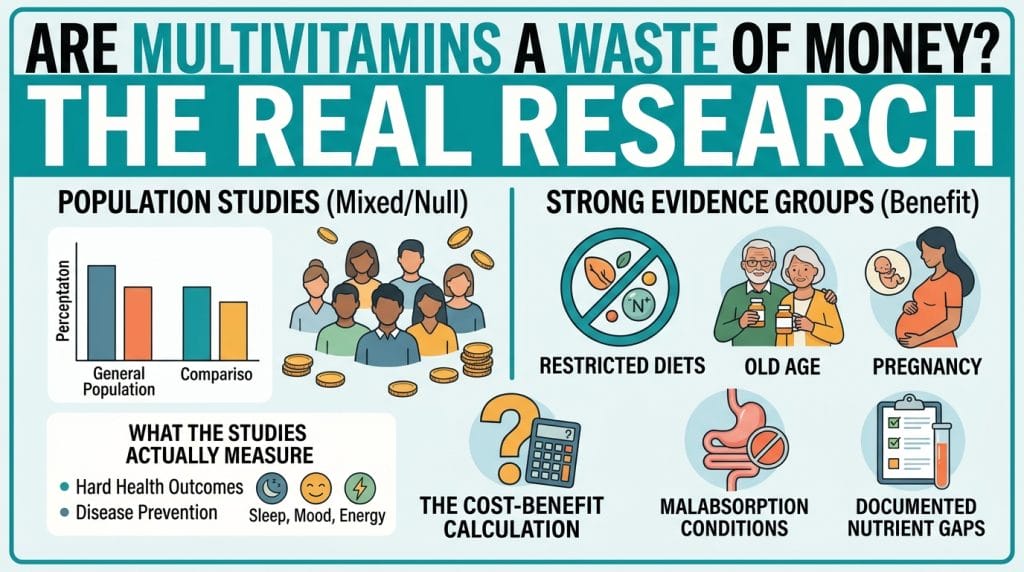
Large population studies on multivitamins and hard health outcomes — like cardiovascular disease, cancer, or overall mortality — have generally found mixed to null results in people who already eat a varied, adequate diet. This has led some researchers and headlines to describe multivitamins as a "waste of money" for the general population. However, this conclusion doesn't apply evenly: the evidence for benefit is considerably stronger in specific groups — including people with restricted diets, documented nutrient gaps, pregnancy, older age, or malabsorption conditions. The honest answer is neither "everyone should take one" nor "nobody needs one," but depends heavily on individual diet quality and risk factors.
"Are multivitamins a waste of money?" is a legitimate, well-researched question — and most of the content answering it online falls into one of two unhelpful camps: supplement companies insisting everyone needs one, or contrarian headlines declaring the entire category useless based on studies that don't actually say that. The real research is more interesting and more useful than either extreme. This guide walks through what the actual large-scale studies found, why population-level null results don't necessarily apply to any specific individual, which groups have much stronger evidence for benefit, and how to think about the cost-benefit question for your own situation rather than relying on a one-size-fits-all headline.
What this article covers
- What the major studies actually found
- Why "no effect on average" doesn't mean "no effect for you"
- Groups where the evidence for benefit is much stronger
- What these studies were actually measuring — and what they weren't
- The actual cost-benefit and risk calculation
- When a multivitamin genuinely is a waste of money
- A better question than "waste of money or not"
- Frequently asked questions
What the major studies actually found

Several large, well-conducted studies have specifically examined whether multivitamin use reduces the risk of major health outcomes in generally healthy adult populations. The results are more nuanced than most headlines suggest.
Save this article for later
Enter your email and we'll send you a direct link — no account needed.
The Physicians' Health Study II
A large, long-term randomized controlled trial following over 14,000 male physicians found that daily multivitamin use was associated with a statistically significant reduction in total cancer incidence, though it found no significant effect on cardiovascular disease or overall mortality [1]. This is frequently cited as one of the higher-quality studies in this space precisely because it was randomized (rather than observational) and followed a large cohort over more than a decade.
The U.S. Preventive Services Task Force review
A 2013 systematic evidence review conducted for the USPSTF concluded that existing evidence was insufficient to recommend for or against multivitamin use for the primary prevention of cardiovascular disease or cancer in the general adult population — importantly, "insufficient evidence to recommend" is a different conclusion than "proven not to work" [2].
Observational cohort studies
Multiple large observational studies tracking multivitamin users over time have found generally mixed associations with mortality and chronic disease outcomes — some showing modest benefit, others showing none, and few showing harm at typical multivitamin doses [3]. Observational studies in this area are also limited by "healthy user bias" — people who take multivitamins regularly often have other health-conscious behaviors that are difficult to fully separate from the supplement's own effect.
The honest summary
Taken together, the strongest available evidence suggests multivitamins do not produce dramatic reductions in major chronic disease risk for a general, already well-nourished adult population. They also have not been shown to cause meaningful harm at standard doses in most healthy adults. This is a genuinely different conclusion than "multivitamins are useless" or "multivitamins are a scam" — it's closer to "multivitamins are not a substitute for a healthy diet and are not a guaranteed disease-prevention tool for people who are already well-nourished."
Why "no effect on average" doesn't mean "no effect for you"

This is the single most important statistical concept for interpreting these studies correctly, and it's the piece most headlines skip.
Large population studies measure the average effect across an entire study group. If a group of 10,000 people includes both people with genuine nutrient gaps (who may benefit meaningfully) and people who are already fully nutrient-replete from diet (who have little room for further benefit), the average effect across the whole group can look small or null — even if a meaningful subgroup genuinely benefited.
This statistical reality means a null result at the population level is fully consistent with real benefit existing for specific individuals with specific gaps. It's the equivalent of studying whether umbrellas prevent people from getting wet and finding "no significant effect" because most of the study group was tested on days it wasn't raining — the umbrella still works, the population-level result just doesn't reflect the individual cases where it actually mattered.
Groups where the evidence for benefit is much stronger
Rather than one blanket answer, the research is considerably clearer for specific, well-defined groups:
- People with restricted diets (vegan, vegetarian, or otherwise limited variety) — clear evidence of gaps for specific nutrients like B12, iron, zinc, and iodine [4]
- Pregnant women — strong evidence specifically for folate (neural tube defect prevention) and iron
- Older adults — particularly for vitamin B12, given well-documented age-related absorption decline, and vitamin D, given reduced skin synthesis efficiency with age
- People with documented malabsorption conditions (Crohn's disease, celiac disease, gastric bypass history) — genuine, well-established need regardless of diet quality
- People with limited sun exposure — specifically relevant for vitamin D status
- People with a confirmed lab-tested deficiency in any specific nutrient — the clearest case of all, since correction of an actual documented deficiency has strong evidence behind it, independent of the general population studies discussed above
Notice that the strength of evidence in these groups isn't really about "multivitamins" as a blanket category — it's about whether a real, identifiable nutritional gap exists that the multivitamin is filling.
What these studies were actually measuring — and what they weren't

It's worth being precise about what "no significant effect" actually refers to in these studies, since it's often misunderstood.
Most of the large studies discussed above were designed to detect effects on major clinical endpoints — cardiovascular events, cancer diagnosis, or death — over years of follow-up. They were generally not designed to measure, and mostly didn't measure, softer outcomes like:
- Correcting a mild subclinical deficiency before it becomes symptomatic
- Day-to-day energy levels, mood, or cognitive function
- Immune function during specific periods of stress or illness
- Nutrient status improvements that reduce risk of secondary conditions not tracked as a primary endpoint
A multivitamin could plausibly provide meaningful value along these dimensions without ever showing up as a statistically significant reduction in cancer or heart disease incidence in a 10-year trial — these are simply different questions than the ones the landmark studies were designed to answer.
The actual cost-benefit and risk calculation

Setting aside the "does it prevent disease" question, a more practical framework is comparing realistic cost against realistic risk:
The realistic risk side
For most water-soluble vitamins (B-complex, vitamin C) at standard multivitamin doses, the safety margin is very wide, and the risk of harm from typical daily use is low. The more relevant risk considerations are for fat-soluble vitamins (A, D, E, K) and certain minerals (iron, in particular) at doses meaningfully above the Tolerable Upper Intake Level — which is why checking specific doses against established upper limits matters more than a blanket safety assumption in either direction.
The realistic cost side
A daily multivitamin typically costs a small fraction of most other routine health or wellness expenses. For someone with any of the risk factors described in Section 3, or simply someone who doesn't consistently eat a highly varied diet, this cost is generally low relative to the plausible benefit of closing real nutritional gaps — even without proof of dramatic disease-prevention effects.
The opportunity cost consideration
The more legitimate cost-related critique isn't the price of the multivitamin itself, but the risk of using it as a substitute for addressing diet quality, sleep, exercise, or other higher-impact health behaviors. A multivitamin is reasonably understood as a supplement to a healthy pattern, not a replacement for one.
When a multivitamin genuinely is a waste of money

Being balanced means acknowledging real scenarios where the "waste of money" critique has genuine merit:
- Buying an expensive multivitamin as a substitute for improving an actually poor diet, rather than as a supplement to a reasonable one
- Taking a multivitamin with doses far below meaningful levels for the nutrients you're actually short on, while paying a premium for marketing or brand positioning
- Stacking multiple overlapping supplements without checking cumulative doses, which can waste money on redundant nutrients or, in some cases, push fat-soluble vitamins or iron above recommended upper limits
- Taking a multivitamin instead of getting tested when a specific, correctable deficiency is likely — targeted correction of a confirmed deficiency is usually more cost-effective and more clearly evidence-supported than a broad, untargeted approach
A better question than "waste of money or not"

Given everything above, the more useful individual question isn't "do multivitamins work," but: "do I have an actual nutritional gap that a multivitamin would help close?"
This reframes the decision around your own specific diet, risk factors, and — ideally — lab-tested nutrient status, rather than a population-level statistic that may or may not apply to your particular situation. Someone eating an excellent, highly varied diet with no risk factors is in a genuinely different position than someone with a restricted diet, a documented deficiency, or an age-related absorption concern — and the research supports treating those as different questions rather than one universal answer.
For those who've identified real gaps worth addressing, a comprehensive formula that covers commonly under-consumed nutrients — including ones frequently missing even from other multivitamins, like EPA and DHA omega-3s and choline — is one reasonable way to close several gaps in a single daily serving. The Vitamin Shots and Vitamin Sprinkles were formulated with this comprehensive-coverage approach. Explore the full product line at thevitaminshots.com.

Frequently asked questions
Do multivitamins actually work?
It depends on what "work" means. Large studies have not shown multivitamins dramatically reduce major disease risk in well-nourished adults on average. However, for people with restricted diets, documented deficiencies, pregnancy, older age, or malabsorption conditions, the evidence for meaningful benefit is considerably stronger. The honest answer depends on individual circumstances rather than being universally yes or no.
What did the Physicians' Health Study II actually find about multivitamins?
This large randomized controlled trial of over 14,000 male physicians found daily multivitamin use was associated with a statistically significant reduction in total cancer incidence, but no significant effect on cardiovascular disease or overall mortality.
If studies show no effect on average, does that mean multivitamins don't work for me personally?
Not necessarily. Population-level "no significant effect on average" results are consistent with real benefit existing for specific individuals with actual nutrient gaps, since averaging across people who are well-nourished and people who are deficient can mask a real effect in the deficient subgroup.
Who has the strongest evidence for benefiting from a multivitamin?
People with restricted diets (vegan, vegetarian, or limited variety), pregnant women, older adults, people with documented malabsorption conditions, those with limited sun exposure, and anyone with a confirmed lab-tested deficiency have the clearest, strongest evidence for meaningful benefit.
Are multivitamins dangerous to take?
At standard doses, most water-soluble vitamins carry a wide safety margin and low risk. The more relevant safety considerations are for fat-soluble vitamins (A, D, E, K) and iron at doses meaningfully above the Tolerable Upper Intake Level, which is why checking specific doses matters more than a blanket assumption of safety or danger.
Should I get tested before deciding whether to take a multivitamin?
Testing for common markers like vitamin B12, 25-hydroxyvitamin D, and ferritin (iron stores) is a more precise way to determine individual need than relying on general population studies. Targeted correction of a confirmed deficiency has stronger evidence behind it than broad, untargeted supplementation.
Why do some studies show multivitamins reduce cancer risk and others don't?
Different studies have different populations, follow-up durations, multivitamin formulations, and baseline nutrient status among participants, all of which can affect results. The Physicians' Health Study II found a cancer benefit; other studies have found null results for cancer specifically. This variation reflects real differences in study design and populations rather than a single definitive answer either way.
Is it better to get nutrients from food instead of a multivitamin?
Whole foods generally provide additional benefits beyond isolated nutrients, including fiber and other bioactive compounds, and are the preferred primary source when achievable. A multivitamin is more accurately understood as filling gaps in an imperfect diet rather than being nutritionally equivalent to or a replacement for whole foods.
What's the difference between "insufficient evidence" and "proven not to work"?
These are meaningfully different conclusions. "Insufficient evidence to recommend for or against," as the USPSTF review concluded, means the available research doesn't clearly settle the question either way — not that the research proved multivitamins are ineffective. This distinction is frequently lost in headline summaries of the underlying studies.
What's a more useful way to decide if I personally need a multivitamin?
Rather than relying on a population-level statistic, consider your own diet variety, any restricted eating patterns, age, pregnancy status, known malabsorption conditions, and ideally recent blood work for common markers like B12, vitamin D, and ferritin. This individual assessment is more informative than a single blanket answer about multivitamins as a category.
References & sources
- Gaziano JM, Sesso HD, Christen WG, et al. Multivitamins in the prevention of cancer in men: the Physicians' Health Study II randomized controlled trial. JAMA. 2012;308(18):1871-1880.
- Fortmann SP, Burda BU, Senger CA, Lin JS, Whitlock EP. Vitamin and mineral supplements in the primary prevention of cardiovascular disease and cancer: a systematic evidence review for the U.S. Preventive Services Task Force. Annals of Internal Medicine. 2013;159(12):824-834.
- Watkins ML, Erickson JD, Thun MJ, Mulinare J, Heath CW. Multivitamin use and mortality in a large prospective study. American Journal of Epidemiology. 2000;152(2):149-162.
- Academy of Nutrition and Dietetics. Position of the Academy of Nutrition and Dietetics: Vegetarian Diets. Journal of the Academy of Nutrition and Dietetics. 2016;116(12):1970-1980.
- National Institutes of Health, Office of Dietary Supplements. Multivitamin/mineral Supplements — Fact Sheet for Health Professionals. ods.od.nih.gov